
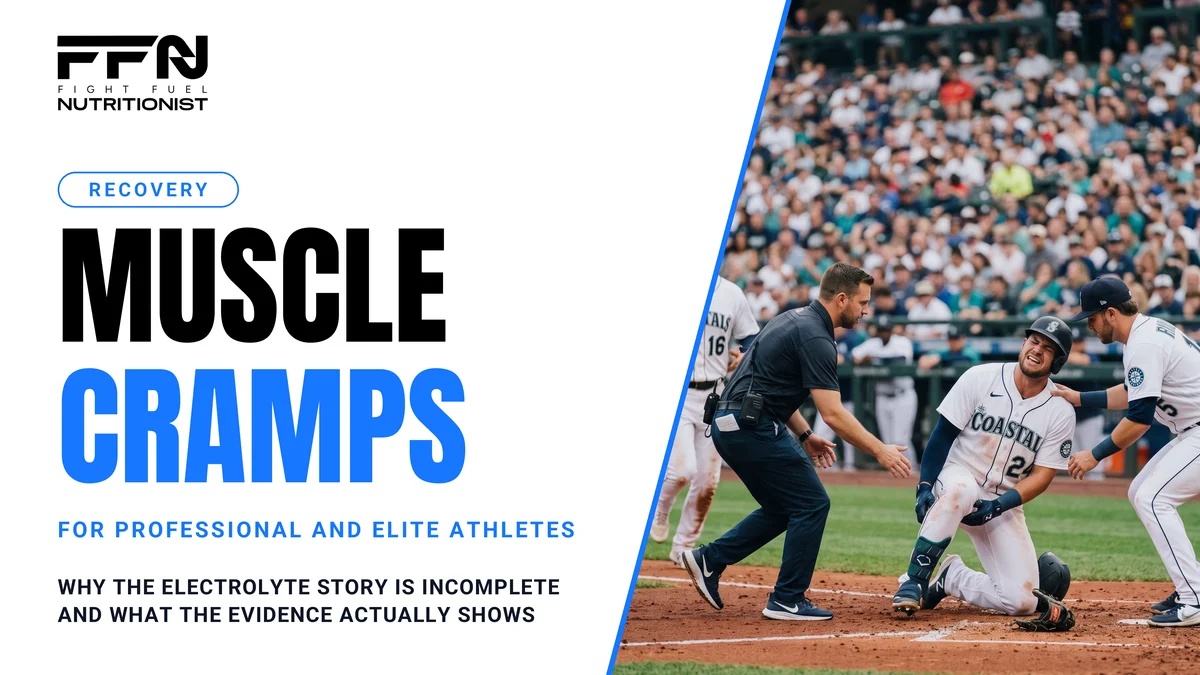
Why athletes cramp, what the evidence supports, and how to think about prevention and treatment
Few problems in sport are as common, as poorly understood, and as frustrating as muscle cramps. Almost every athlete has experienced one — a sudden, painful muscle that locks up without warning and can stop performance in seconds. Surveys of endurance athletes suggest more than half experience cramps during or after competition, with a smaller group affected severely enough to compromise performance.
Despite how common cramps are, the science behind them is far less settled than most athletes assume. The dominant explanation for decades — that dehydration and sodium loss cause cramps — has limited evidence behind it. The leading current explanation, that changes in nerve control of muscles under fatigue cause cramps, has stronger support but is still difficult to study directly. As a result, much of the advice athletes receive about cramps rests on assumptions, not on solid evidence.
For professional and elite athletes, this matters. Cramping during competition can end a match, a race, or a final. Cramping in training disrupts adaptation. Moreover, the products and practices marketed to “prevent” cramps — electrolyte tablets, mustard, pickle juice, magnesium supplements, banana eating — have varying levels of evidence behind them, and the right approach depends on understanding what actually causes cramps in the first place.
This article covers what the evidence shows about why athletes cramp, where the dehydration and sodium explanation holds and where it does not, what the nerve control explanation tells us, and how professional athletes should think about prevention and treatment.
Key Points
- Muscle cramps are sudden, painful muscles that lock up on their own during or after training and competition
- More than half of endurance athletes experience cramps at some point, with a smaller group experiencing severe or recurring cramps
- The dehydration and sodium explanation is the classical one, but the direct evidence supporting it in athletes is surprisingly limited
- The nerve control explanation — that changes in how nerves control muscles under fatigue cause cramps — has stronger and more recent evidence
- Both mechanisms likely play a role in different situations, and a single explanation does not fit all cramps
- Risk factors include older age, history of previous cramping, hot and humid conditions, intense or unfamiliar effort, and competition demands that exceed training preparation
- Prevention is best approached through training specificity (preparing the muscles for the actual demands of competition) and managing sodium and fluid losses
- Treatment options during a cramp are limited — stretching, reducing intensity, and pickle juice have some support, but most cramps resolve on their own
What a Muscle Cramp Actually Is
The basic picture
A muscle cramp is a sudden, painful muscle that locks up without warning. The muscle contracts hard on its own and stays contracted until something — rest, stretching, or time — allows it to release.
Cramps can vary widely in severity:
- Brief, mild cramps in small muscle groups that resolve in seconds
- Sustained cramps in larger muscle groups (calves, hamstrings, quadriceps) that can last minutes
- Severe whole-body cramps that can leave an athlete in pain for hours or days afterward
Moreover, cramps can strike during training, during competition, immediately after stopping, or even hours later — sometimes overnight.
How common cramps are in athletes
Cramping is most commonly reported in endurance sports, where the long duration and repeated muscle contractions seem to make athletes more vulnerable. However, cramps occur in essentially every sport — including team sports, combat sports, racket sports, and skill-based sports.
Surveys of endurance athletes suggest 60 to 70% have experienced cramps during or after competition at some point in their careers, with around 4% reporting severe or competition-ending cramps. In team sports played in heat, cramping rates climb considerably higher, particularly in late-game situations.
Key Takeaway
✔ Muscle cramps are sudden, painful muscles that lock up on their own and affect athletes across virtually every sport. More than half of endurance athletes experience cramps at some point, with smaller numbers affected severely.
The Dehydration and Sodium Explanation
The classical explanation
For most of the 20th century, the dominant explanation for muscle cramps was straightforward: dehydration and loss of electrolytes (particularly sodium) through sweat disrupt muscle function and cause cramping. Because the body needs electrolytes for normal muscle contraction and relaxation, the reasoning was that losing them through heavy sweating would trigger uncontrolled contractions.
This explanation makes intuitive sense, and it has anchored much of the marketing around electrolyte products in sport. Moreover, it fits with the observation that cramps strike more often in hot conditions, where sweat losses are highest.
Where the explanation comes from
The original evidence supporting this explanation came from work in the 1920s and 1930s on industrial workers — miners, steel mill workers, and ship stokers — who worked long hours in extreme heat and full protective clothing. These workers experienced very high rates of cramping, and giving them sodium-containing drinks (rather than plain water) reduced cramp incidence dramatically.
In one well-known example, workers in one steel mill drank plain water throughout the day while workers in a nearby mill drank sodium drinks. The mill providing sodium saw cramping rates fall sharply.
Where the explanation falls short
However, the working conditions of early 20th century industrial labor do not match modern sport. More recent work in athletes has produced mixed results:
- Some evidence shows that athletes who cramp tend to have higher sweat sodium losses and tend to drink more plain water than those who do not cramp
- Other evidence has failed to find consistent differences in hydration status or sodium balance between athletes who cramp and those who do not
- Cramps frequently strike athletes who are not dehydrated and have normal sodium balance
- Cramps also strike in cool conditions, where sweat losses are minimal
- Electrolyte intake has not prevented cramps in laboratory testing that uses electrical stimulation to trigger them
Cramping situations where sodium and fluid losses likely contribute
In other words, although dehydration and sodium loss likely contribute to cramping in some situations — particularly in heat, with very high sweat losses, in heavy and salty sweaters — they cannot fully explain why athletes cramp.
Key Takeaway
✔ The dehydration and sodium explanation accounts for some cramps, particularly in heat and in heavy salty sweaters. However, the evidence in athletes is mixed, and many cramps occur without any dehydration or sodium problem. Therefore, this cannot be the complete explanation.
The Nerve Control Explanation
What this explanation says
The leading current explanation for cramps during training and competition is that changes in how nerves control muscle contraction under fatigue cause them. When a muscle fatigues, the balance between two systems shifts:
- The nerve signals that tell the muscle to contract become more active
- The nerve signals that normally limit excessive contraction become less active
As a result, the muscle ends up receiving uncontrolled signals to contract, producing the locked-up muscle of a cramp.
In other words, cramps under this explanation reflect a problem of nerve control gone temporarily wrong — not a problem of fluid and sodium balance.
Where this explanation fits the evidence better
Several findings support this explanation:
- Cramps strike athletes who are well-hydrated and have normal sodium balance
- Cramps strike in cool conditions where sweating is minimal
- Cramps are more common when athletes train or compete beyond what they have prepared for — exceeding their conditioning
- Athletes prone to cramping need less electrical stimulation to trigger a cramp than those who are not
- Blocking nerve signals with anesthetic raises the stimulation needed to trigger a cramp
- Cramps frequently strike muscles that have been working hard — not necessarily in the most-sweated areas
The pattern of cramping in athletes fits better with a nerve control problem driven by fatigue and intense effort than with a simple sodium deficit.
Why this matters for prevention and treatment
If a nerve control problem is the primary cause of cramps, then the most effective prevention is conditioning the muscle for the demands of competition. Training that matches the duration, intensity, and movement patterns of competition reduces the fatigue-driven nerve changes that trigger cramps.
This explains why elite athletes who suddenly compete at higher intensity than they trained for — early-season competitions, championship-level efforts, unfamiliar conditions — face more cramping risk than those whose training has matched competition demands.
Key Takeaway
✔ The nerve control explanation fits the evidence better than the dehydration and sodium explanation in many cases. Changes in how nerves control muscles under fatigue likely cause cramps, particularly when competition demands exceed training preparation.
Why Both Mechanisms Probably Matter
Different cramps, different causes
The most likely picture is that both mechanisms play roles, in different situations, in different athletes:
- A heavy, salty sweater training in extreme heat for hours may genuinely lose enough sodium to contribute to cramping
- An athlete competing at higher intensity than their training prepared them for may cramp from changed nerve control under fatigue, with no sodium issue at all
- An athlete with both factors — heat, heavy sweat losses, and intense effort beyond their conditioning — may experience cramps driven by both mechanisms together
“What causes muscle cramps” does not have a single answer. Cramps in different contexts have different causes, and the right prevention strategy depends on the situation.
Risk factors
Across the evidence, several risk factors emerge as consistently associated with higher cramping rates:
- Previous history of cramping (the strongest single predictor)
- Older age
- Family history of cramping
- Heavy and salty sweat losses
- Hot and humid conditions
- Competition intensity exceeding training preparation
- Recent change in training, equipment, or position (e.g., a new bike fit, a new playing surface)
- Inadequate sleep or recovery
- Some medications (statins, diuretics, beta-agonists)
- Underlying medical conditions (rare but worth considering for athletes with persistent cramping)
Key Takeaway
✔ Different cramps likely have different causes — sometimes sodium and fluid losses, sometimes changed nerve control under fatigue, often both. Therefore, prevention and treatment should match the situation rather than apply generically.
Prevention: What the Evidence Supports
Training specificity is the most important factor
The single most important prevention strategy is training that matches the demands of competition. Athletes who train at the duration, intensity, and movement patterns of their actual competition cramp far less often than those whose training falls short of competition demands.
In practice, this means:
- Building training volume and intensity progressively to match competition
- Including sport-specific movements, positions, and patterns regularly
- Avoiding sudden jumps in competition demand without training preparation
- Replicating competition conditions (heat, humidity, surface, equipment) where possible
Managing fluid and sodium losses
Although the evidence for sodium replacement preventing cramps is mixed, managing fluid and sodium losses still makes sense — particularly for athletes with heavy sweat losses, those competing in heat, and those with a history of cramping.
In practice:
- Know your individual sweat rate and sweat sodium concentration through testing
- Use sodium-containing drinks during long training and competition, particularly in heat
- For heavy and salty sweaters, higher-sodium products (oral rehydration solutions, electrolyte tablets at higher concentrations) may help
- Avoid drinking large volumes of plain water without sodium during long efforts — this can dilute blood sodium and may contribute to cramping in some athletes
Other preventive practices
A number of other practices have anecdotal or limited support:
- Adequate carbohydrate availability during training and competition (fatigue contributes to cramping)
- Adequate sleep and recovery between hard sessions
- Massage, stretching, and mobility work as part of regular routine (although evidence for stretching specifically preventing cramps is limited)
- Magnesium supplementation has very limited supporting evidence in athletes, despite heavy marketing for cramps
What probably does not help
Some commonly recommended approaches have weak or no evidence:
- Magnesium supplements in athletes who are not deficient
- Calcium supplements in athletes who are not deficient
- Banana eating before competition (the potassium content is too small to affect cramping)
- Generic “electrolyte” tablets used without knowledge of individual sweat sodium losses
Key Takeaway
✔ The strongest cramp prevention is training that matches competition demands. Managing fluid and sodium losses helps in some situations, particularly heat and heavy salty sweaters. However, many commonly marketed cramp prevention products have limited evidence behind them.
Treatment: What to Do When a Cramp Strikes
Reduce intensity and rest
The first response to most cramps is to reduce intensity or stop briefly. Many cramps resolve in seconds to minutes on their own once the muscle is allowed to relax. In low-stakes settings, simply slowing down or stopping is often enough.
Stretching
Stretching the affected muscle is the most commonly used treatment for an active cramp. Gentle, sustained stretching of the cramping muscle can shorten the length of the cramp by activating reflexes that signal the muscle to release.
Why stretching evidence is mixed but practical
The evidence for stretching is limited but practical — case reports and clinical experience support it, even though laboratory testing on electrically induced cramps has not always shown a clear effect. Stretching remains one of the most useful tools available during a cramp.
Pickle juice and salty solutions
Small amounts of pickle juice (around 1 ml/kg of body weight) can shorten cramp duration. The effect appears within 30 to 90 seconds — too fast for sodium absorption and electrolyte rebalancing to explain.
The leading explanation is that the strong taste and acidic content trigger a signal in your mouth and throat that tells your brain to release the cramping muscle. Pickle juice (and similar strong-tasting solutions like mustard) may work through a brain-and-nerve pathway, not through sodium replacement.
This is interesting and may be worth trying in situations where cramps are recurring and other tools are not working. However, the evidence base is small, and pickle juice is not a guaranteed solution.
Hydration and sodium intake
If the cramp occurs in a context where dehydration or sodium loss may contribute — long efforts in heat, heavy sweat losses, prolonged plain-water drinking — replacing fluids and sodium during and after the event makes sense. However, expecting sodium intake to resolve an active cramp quickly is unrealistic. Electrolytes are better viewed as part of recovery and prevention strategy than as acute treatment.
When to see a medical professional
Most cramps during training and competition are not serious and resolve without medical intervention. However, athletes should see a medical professional if:
- Cramps are severe, recurring, or interfering with training and competition
- Cramps occur outside of training (at rest, overnight, frequently)
- Cramps come with other symptoms (weakness, swelling, abnormal urine color)
- The athlete takes medications associated with cramping
- There is a family history of muscle disorders
| Situation | Best Approach |
|---|---|
| Mild cramp during training | Reduce intensity, brief rest |
| Cramp during competition | Stretching, brief rest, continue if possible |
| Severe or sustained cramp | Stop, stretch, hydrate with sodium, consider medical attention if not resolving |
| Recurring cramps over a season | Review training preparation, sweat testing, medical evaluation if persistent |
Key Takeaway
✔ Treatment options for active cramps are limited but include reducing intensity, stretching, and in some cases pickle juice or strong-tasting solutions. Most cramps resolve on their own within minutes. Therefore, prevention through training specificity and managing fluid and sodium losses matters more than treatment.
Conclusion
Muscle cramps are one of the most common and least understood problems in sport. They affect more than half of endurance athletes at some point, occur across virtually every sport, and can have real consequences in competition.
The science of cramping is less settled than the marketing around it suggests. The classical dehydration and sodium explanation accounts for some cramps but cannot account for many — and the nerve control explanation fits the evidence better in many situations. Both mechanisms likely play roles in different contexts, in different athletes.
For professional and elite athletes, the practical message is direct. Training that matches the demands of competition is the most important preventive measure. Managing fluid and sodium losses helps in some situations, particularly heat and heavy salty sweaters. Treatment of active cramps is limited but includes stretching, reducing intensity, and in some cases strong-tasting solutions like pickle juice.
Above all, the athletes who cramp least are usually those whose training has prepared them for what they actually face in competition — not those who consume the most electrolyte products.
Key Takeaway
✔ A combination of changed nerve control under fatigue and, in some situations, fluid and sodium losses most likely causes muscle cramps in sport. Therefore, prevention is best approached through training specificity, individualized fluid and sodium management, and an honest read of what the evidence actually supports.
References
- Maughan RJ, Shirreffs SM. (2019). Muscle cramping during exercise: causes, solutions, and questions remaining. Sports Medicine, 49(Suppl 2), 115–124.
- Schwellnus MP. (2009). Cause of exercise associated muscle cramps (EAMC) — altered neuromuscular control, dehydration or electrolyte depletion? British Journal of Sports Medicine, 43(6), 401–408.
- Schwellnus MP, Drew N, Collins M. (2011). Increased running speed and previous cramps rather than dehydration or serum sodium changes predict exercise-associated muscle cramping: a prospective cohort study in 210 Ironman triathletes. British Journal of Sports Medicine, 45(8), 650–656.
- Miller KC, Mack GW, Knight KL, et al. (2010). Reflex inhibition of electrically induced muscle cramps in hypohydrated humans. Medicine and Science in Sports and Exercise, 42(5), 953–961.
- Miller KC, Mack GW, Knight KL. (2009). Electrolyte and plasma changes after ingestion of pickle juice, water, and a common carbohydrate-electrolyte solution. Journal of Athletic Training, 44(5), 454–461.
- Jung AP, Bishop PA, Al-Nawwas A, Dale RB. (2005). Influence of hydration and electrolyte supplementation on incidence and time to onset of exercise-associated muscle cramps. Journal of Athletic Training, 40(2), 71–75.
- Sawka MN, Burke LM, Eichner ER, et al. (2007). Exercise and fluid replacement. Medicine and Science in Sports and Exercise, 39(2), 377–390.
- Baker LB. (2017). Sweating rate and sweat sodium concentration in athletes: a review of methodology and intra/interindividual variability. Sports Medicine, 47(Suppl 1), 111–128.
- Minetto MA, Holobar A, Botter A, Farina D. (2013). Origin and development of muscle cramps. Exercise and Sport Sciences Reviews, 41(1), 3–10.


