
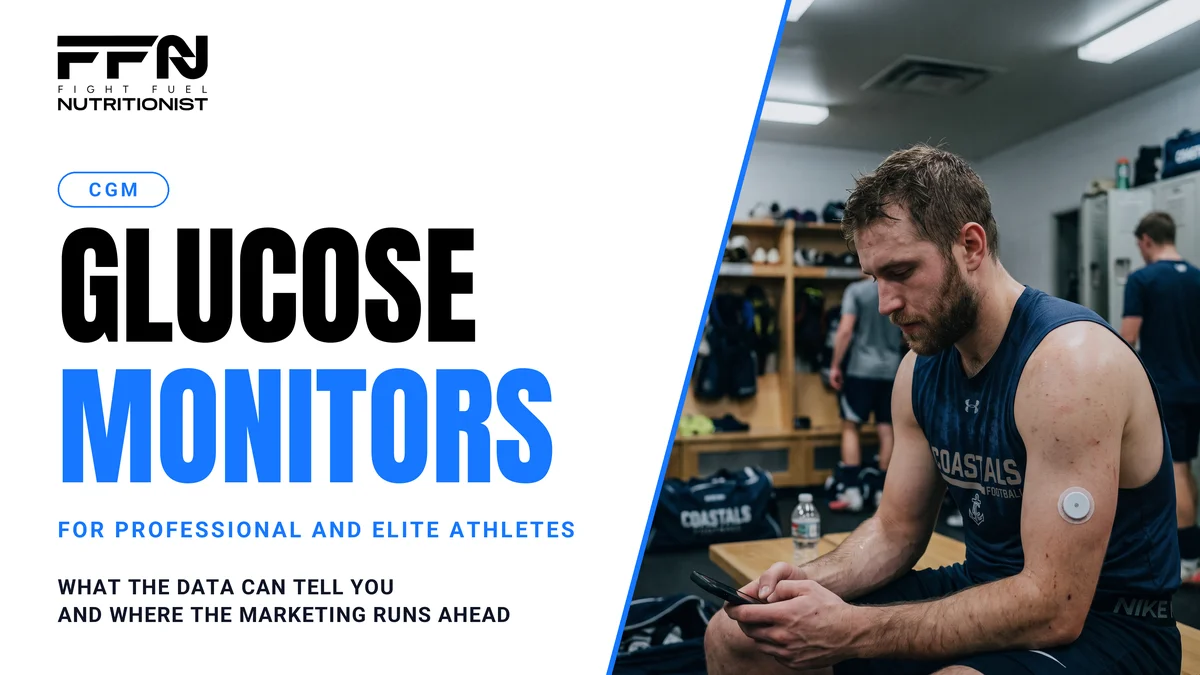
What CGM measures, what the evidence shows about glucose in athletes, and how to use the technology without misreading the data
Continuous glucose monitors have moved from the diabetes clinic into elite sport over the past decade. Sensors that were originally developed to manage type 1 and type 2 diabetes are now worn by endurance athletes, team sport players, and combat sports competitors who want insight into how their bodies respond to training, competition, recovery, and food. Moreover, the technology has been heavily marketed to recreational athletes and the wider public, with claims about personalized fueling, optimized recovery, and metabolic health.
For professional and elite athletes, the question is straightforward: what can CGM actually tell you, and how should you use it? However, the answer is more complicated than the marketing suggests. The evidence base on CGM in athletes without diabetes is recent and still developing, the technology has known accuracy limitations during training, and the way data is interpreted varies enormously across users — with meaningful consequences for fueling decisions, food choices, and confidence in nutrition strategy.
This article covers what CGM actually measures, what the evidence shows about glucose during training and competition, the legitimate roles for CGM in elite sport, the limitations of the technology, and how a professional athlete should approach the decision to use one.
Key Points
- Continuous glucose monitors (CGMs) measure blood sugar continuously through a small sensor worn on the skin, originally developed and validated for diabetes management
- CGM use in athletes without diabetes is a recent development — the evidence base is still emerging and agreed targets for “good” or “bad” glucose patterns in this group have not been established
- Glucose patterns in athletes are shaped by training timing, training intensity, recovery status, sleep, stress, menstrual cycle phase, and the carryover effects of previous meals — not just by what was just eaten
- Low blood sugar during long endurance events is real and performance-relevant — CGM can identify and inform fueling for these situations
- Sustained low energy availability and high training loads can disrupt blood sugar control in elite endurance athletes, with potential health implications
- CGM has known accuracy limitations during rapid glucose changes, intense training, sweat exposure, and mechanical disruption — relevant in many sport contexts
- A single glucose peak after a meal does not indicate prediabetes or diabetes, which are defined by chronically elevated glucose
- For most professional athletes, CGM is most useful when used selectively, with clear questions, professional support, and an understanding of what glucose data can and cannot tell you
What CGM Actually Measures
How the technology works
A continuous glucose monitor is a small sensor worn on the back of the upper arm or abdomen. It contains a fine filament that sits just under the skin and measures glucose in the fluid just under your skin, which closely tracks blood sugar with a small lag of 5 to 15 minutes.
The sensor reads glucose every 1 to 5 minutes and transmits the data to a phone or reader. As a result, the user sees a continuous curve of glucose values across hours and days, instead of the single snapshot a fingerstick test provides. The most widely used systems in sport include the Abbott FreeStyle Libre and Dexcom devices, alongside a growing number of consumer-focused devices that build on the same underlying sensor technology.
Originally developed for diabetes
CGM was developed and validated for people with type 1 and type 2 diabetes. In this population, CGM is part of standard medical care — supporting insulin dosing, identifying dangerous low blood sugar episodes, and tracking blood sugar response to meals, training, and medication. International consensus has established target ranges, time-in-range goals, and clinical interpretations for people with diabetes, supported by large-scale data and outcomes research.
Use in athletes without diabetes is recent
In contrast, the use of CGM in athletes without diabetes is much more recent. The evidence base on glucose patterns in healthy athletes — and on how those patterns connect to performance and health — is still developing. Moreover, no clinical or research consensus currently defines what a “good” or “bad” CGM reading looks like in this population. Much of the interpretation of CGM data in healthy athletes rests on assumptions extrapolated from diabetes research or from the general population, rather than on direct evidence in athletes.
Key Takeaway
✔ CGM measures blood sugar continuously through a sensor worn on the skin and is well-established in diabetes care. However, its use in athletes without diabetes is recent, with no agreed targets for what is “good” or “bad” — and interpretation often rests on assumptions rather than direct evidence.
What the Evidence Shows About Glucose in Athletes
Glucose during training
Blood sugar during training depends on intensity, duration, fed or fasted state, and prior carbohydrate availability:
- During moderate-intensity training, blood sugar typically remains stable or drops modestly as muscle glucose uptake rises
- During high-intensity training, blood sugar often rises because cortisol (your main stress hormone) and adrenaline trigger glucose release from the liver
- During long endurance efforts, blood sugar can drop progressively, particularly when carbohydrate intake during the event is inadequate
Moreover, training within the previous 24 to 48 hours improves how your body handles carbohydrate and reduces the size of post-meal blood sugar peaks. As a result, blood sugar responses to identical meals can vary day-to-day in the same athlete, depending on what training has happened recently.
Blood sugar around meals
In athletes without diabetes, blood sugar after eating typically peaks within 30 to 60 minutes and returns to baseline within 90 to 120 minutes. The size and duration of the peak depend on:
- The carbohydrate amount and type in the meal
- The protein, fat, and fiber content (which slow glucose release)
- The previous meal — meals eaten hours earlier shape the blood sugar response to the next one
- Recent training (which improves how your body handles carbohydrate)
- Sleep quality the previous night
- Stress and cortisol exposure
- Menstrual cycle phase in female athletes
- Recent dietary patterns (including carbohydrate intake over previous days)
In other words, the blood sugar curve after any given meal reflects far more than the meal itself.
Blood sugar during long endurance events
For long endurance events — marathons, ultra-distance running, long-distance cycling, triathlons — maintaining blood sugar across the event is part of performance. When carbohydrate intake during the event is inadequate, blood sugar can drop and impair both physical and mental performance. As a result, CGM has been used to identify fueling problems in this context and to inform carbohydrate intake strategy.
Moreover, the ability of trained endurance athletes to maintain blood sugar during long efforts is often better than in less-trained individuals, reflecting greater capacity to burn fat for fuel and the ability to switch easily between burning fat and carbs.
Blood sugar problems in high training loads
One of the more interesting recent findings comes from work on elite endurance athletes during periods of very high training load. Evidence has shown that sustained high training volume — particularly when combined with low energy availability — can disrupt blood sugar control, with athletes showing a reduced ability to handle carbohydrate and patterns you would expect to see in someone whose metabolism is struggling, rather than the metabolic health usually associated with elite training.
This is a meaningful finding because it suggests that CGM data in elite athletes is not always a reflection of health, and that very high training loads may push blood sugar patterns in unhealthy directions when not matched by adequate nutrition and recovery.
Key Takeaway
✔ Blood sugar patterns in athletes are shaped by training intensity, training timing, recovery status, sleep, stress, menstrual cycle, and previous meals. Sustained high training loads with inadequate nutrition can disrupt blood sugar control in elite athletes — a finding with both performance and health implications.
Where CGM Has Legitimate Roles in Elite Sport
Diabetes management
For athletes with diagnosed type 1 or type 2 diabetes, CGM is essential and well-established. It supports insulin dosing decisions, identifies dangerous lows during and after training, and informs nutrition strategy around competition. International consensus statements provide clear guidance for this population, and CGM use here is not a matter of debate.
Identifying genuine fueling problems
In athletes without diabetes, CGM can identify real, performance-relevant blood sugar problems during long endurance events. Athletes who experience drops in performance during the back half of long efforts may benefit from CGM data showing whether their in-event carbohydrate intake is keeping blood sugar stable.
This is the context where CGM data connects most directly to a measurable performance outcome.
Informing fueling strategy in long endurance events
For ultra-endurance athletes, marathon runners, long-distance cyclists, and triathletes, CGM can support carbohydrate intake decisions during multi-hour events. Athletes can use CGM data — alongside perceived effort, heart rate, and post-event analysis — to refine their in-event fueling protocol. This is one of the most useful applications of CGM in healthy athletes.
Detecting nighttime lows in heavy training periods
CGM can also detect overnight blood sugar drops during periods of heavy training and inadequate nutrition. Athletes who under-fuel relative to their training demands may experience nighttime blood sugar drops that affect sleep quality and recovery — and that they would not otherwise know about.
Increasing food awareness
For some athletes, the visibility of CGM data creates useful awareness of how meals, training, sleep, and stress interact. This can support better adherence to a structured nutrition plan and more deliberate food choices. However, this benefit depends entirely on how the data is interpreted — and the same data can produce harm in athletes who misread normal patterns as problems.
Performance support and sports science work
In professional sport, CGM is also used by sports science teams and dietitians to gather data on athletes during training camps, competition, or specific protocols. This is a performance support and sports science use rather than a self-management use, and it sits within a broader system of monitoring (training load, sleep, body composition, blood markers).
Key Takeaway
✔ CGM has legitimate roles in elite sport — diabetes management, identifying fueling problems in long endurance events, supporting in-event fueling strategy, detecting nighttime lows in heavy training periods, supporting food awareness, and performance support work. These uses are specific and narrower than the marketing suggests.
The Limitations of CGM in Sport
Accuracy in high-intensity and dynamic conditions
CGM has known accuracy limitations, particularly in conditions common in sport:
- CGMs lag blood sugar by 5 to 15 minutes — meaningful when blood sugar is changing rapidly
- Accuracy drops during rapid blood sugar changes (intense training, post-meal peaks, lows)
- Sweat, friction, and mechanical disruption from training, contact sports, and equipment can affect sensor adhesion and readings
- Compression of the sensor (e.g., during sleep on the arm) can produce false low readings
- Some sensors are less accurate at very low and very high blood sugar values
CGM data should be interpreted with awareness of these limitations, particularly during and around high-intensity training and competition.
No agreed targets in healthy athletes
As noted earlier, no agreed clinical or research targets define what a “good” or “bad” blood sugar reading looks like in healthy athletes. Applying diabetes-derived thresholds (such as 7.8 mmol/L or 140 mg/dL) to healthy athletes without context risks misinterpretation. Moreover, the range of blood sugar patterns considered normal in healthy people, and how they relate to performance or long-term health, is still being defined.
Glucose is one variable among many
CGM measures one variable. It does not capture insulin, triglycerides, blood pressure, cholesterol, body composition, or many other markers that matter for metabolic and cardiovascular health. As a result, an athlete who optimizes their blood sugar curve has not necessarily optimized their metabolic health — and may have overlooked variables that matter more.
Risk of misinterpretation in healthy athletes
The most common interpretation errors in healthy athletes include:
- Treating brief blood sugar peaks as prediabetes. Both prediabetes and diabetes are defined by chronically elevated blood sugar, not by brief peaks after meals. A peak to 7.8 mmol/L (140 mg/dL) after a meal that returns to baseline within two hours is normal, not a marker of disease
- Assuming “blood sugar variability” in healthy people is harmful. The evidence linking blood sugar variability to harm comes primarily from diabetes populations, where the swings are much larger and more sustained. Whether the smaller fluctuations in healthy people matter for health or performance is not currently well-established
- Attributing every blood sugar response to the food just eaten. Blood sugar response is shaped by sleep, stress, recent training, menstrual cycle, and previous meals — not just by the current meal
- Chasing flat blood sugar curves. A flat curve is not the goal in healthy athletes. Normal blood sugar responses to food include peaks and returns to baseline, and elimination of carbohydrate to flatten the curve undermines the fueling needed for training and competition
Risk of unnecessary food restriction
Misinterpretation of CGM data can lead to unnecessary food restriction. Athletes seeing peaks they read as “bad” may cut out carbohydrates, fruit, or whole-food meals that are actually performance-supporting. As a result, they end up under-fueled, with worse training, slower recovery, and increased illness risk. In some cases, this can contribute to disordered eating patterns.
Key Takeaway
✔ CGM has real limitations in sport — accuracy issues during intense and dynamic conditions, no agreed targets in healthy athletes, and a one-variable view of metabolic health. Moreover, misinterpretation is common and can lead to unnecessary food restriction and worse performance.
How Professional Athletes Should Approach CGM
Decide whether CGM answers a real question
Before using a CGM, an athlete should ask: what specific question am I trying to answer? Useful questions include:
- Am I dropping low during long endurance sessions or events?
- Is my in-event fueling keeping blood sugar stable through the back half?
- Am I experiencing nighttime lows during heavy training?
- How does my blood sugar respond to the specific pre-competition meal I plan to use?
In contrast, less useful questions include:
- How can I avoid every blood sugar peak?
- What food gives me the flattest blood sugar curve?
- How can I “optimize” every meal based on my blood sugar response?
The first set has direct performance or health relevance. The second set tends to lead to misinterpretation and restriction.
Use it for focused, time-limited periods
Most professional athletes do not need long-term continuous CGM use. A focused 2 to 4 week period with clear questions can provide useful data. Beyond that, the marginal value drops sharply, and the risk of over-interpretation rises. Moreover, intermittent use during specific training blocks (preseason, peak training, pre-competition) often produces more useful insight than continuous year-round monitoring.
Interpret data with professional support
CGM data is easy to misread without context. Working with a sports dietitian who understands both blood sugar control and the specific demands of your sport produces far better outcomes than trying to interpret the data alone or relying on consumer app recommendations. Professional athletes should treat CGM as a tool used within a broader nutrition and performance plan, not as a standalone product.
Keep blood sugar in context
Blood sugar is one variable among many. An athlete’s metabolic and performance health depends on training, sleep, energy intake, body composition, blood pressure, lipids, hormones, and many other factors — most of which CGM cannot see. CGM should be used as one input, not as the central focus of nutrition decisions.
| Use Case | CGM Role |
|---|---|
| Diagnosed diabetes | Essential — part of standard medical care |
| Identifying fueling problems in long events | Useful — direct performance relevance |
| Informing in-event carbohydrate strategy | Useful — supports decision-making |
| Detecting nighttime lows in heavy training | Useful — health and recovery relevance |
| Sports science and performance support | Useful — within a broader monitoring system |
| Optimizing every meal | Limited — high risk of misinterpretation |
| Avoiding all blood sugar peaks | Not useful — peaks are normal |
Key Takeaway
✔ For professional athletes, CGM is most useful when used selectively — with clear questions, for focused periods, with professional support, and as one input among many. Chasing flat lines and treating every peak as a problem leads to worse decisions, not better ones.
Conclusion
Continuous glucose monitoring is a powerful tool in the right context. It has transformed diabetes care, and it has legitimate, evidence-supported applications in elite sport — particularly in long endurance events, in periods of heavy training, and in performance support work.
However, the evidence base on CGM in healthy athletes is still developing. No agreed targets define “good” or “bad” blood sugar patterns in this population, the technology has accuracy limitations in many sport contexts, and the relationship between blood sugar patterns and long-term performance or health in athletes is not yet well-established. Moreover, the marketing of CGM to healthy athletes has run ahead of the evidence, with claims about personalized fueling, optimal blood sugar curves, and metabolic health that the data does not currently support.
For professional and elite athletes, the practical message is direct: CGM has uses, but those uses are specific, narrower than the marketing suggests, and best supported by professional interpretation. The athletes who get the most value from CGM are the ones who use it selectively, with clear questions, while keeping blood sugar in context with the many other variables that drive performance and long-term health.
Key Takeaway
✔ CGM is a useful tool in specific situations — diabetes management, identifying fueling problems in long endurance events, supporting in-event fueling strategy, and performance support work. Moreover, professional athletes should use it selectively, interpret data carefully, and not let blood sugar overshadow the variables that matter more.
References
- Battelino T, Danne T, Bergenstal RM, et al. (2019). Clinical targets for continuous glucose monitoring data interpretation: recommendations from the international consensus on time in range. Diabetes Care, 42(8), 1593–1603.
- Riddell MC, Gallen IW, Smart CE, et al. (2017). Exercise management in type 1 diabetes: a consensus statement. The Lancet Diabetes & Endocrinology, 5(5), 377–390.
- Bowler ALA, Whitfield J, Marshall L, et al. (2023). The use of continuous glucose monitors in sport: possible applications and considerations. International Journal of Sport Nutrition and Exercise Metabolism, 33(2), 121–132.
- Holzer R, Bloch W, Brinkmann C. (2022). Continuous glucose monitoring in healthy adults — possible applications in health care, wellness, and sports. Sensors, 22(5), 2030.
- Flockhart M, Nilsson LC, Tais S, Ekblom B, Apró W, Larsen FJ. (2021). Excessive exercise training causes mitochondrial functional impairment and decreases glucose tolerance in healthy volunteers. Cell Metabolism, 33(5), 957–970.
- Sengoku Y, Nakamura K, Ogata H, Nabekura Y, Nagasaka S, Tokuyama K. (2015). Continuous glucose monitoring during a 100-km race: a case study in an elite ultramarathon runner. International Journal of Sports Physiology and Performance, 10(1), 124–127.
- Thomas DT, Erdman KA, Burke LM. (2016). Position of the Academy of Nutrition and Dietetics, Dietitians of Canada, and the American College of Sports Medicine: Nutrition and athletic performance. Journal of the Academy of Nutrition and Dietetics, 116(3), 501–528.
- Mountjoy M, Sundgot-Borgen J, Burke L, et al. (2018). IOC consensus statement on relative energy deficiency in sport (RED-S): 2018 update. British Journal of Sports Medicine, 52(11), 687–697.
- American Diabetes Association. (2024). Standards of care in diabetes — 2024. Diabetes Care, 47(Suppl 1).


