
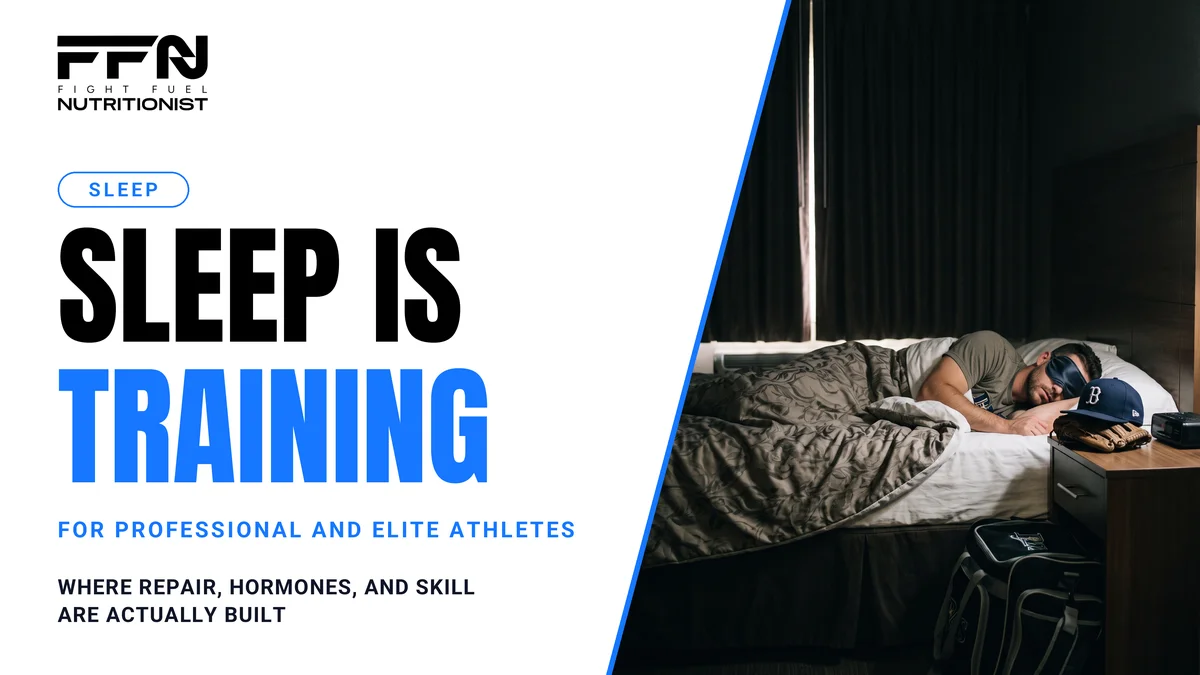
Sleep quality and duration shape performance, recovery, and injury resilience in elite sport
Training harder is not always the answer. At the professional and elite level, the athletes who sustain peak performance over a long career are not necessarily the ones who train the most. Instead, they are the ones who recover the best. Moreover, nothing drives recovery more powerfully than sleep.
Sleep is not passive. It is the period during which your body repairs muscle tissue, restores hormonal balance, consolidates motor skills, and prepares your nervous system for the next demand. Therefore, if you remove it or reduce its quality, every other investment you make in your performance — your training, your nutrition, your preparation — returns less than it should.
Most professional athletes underestimate how much sleep they actually need. Moreover, they overestimate the quality of the sleep they are getting. This article establishes the foundation. It covers what sleep does, what happens when it is insufficient, and what you can do practically to manage it as the performance variable it is.
Key Points
- Sleep directly influences physical output, decision-making, recovery, hormonal balance, and injury risk
- Sleep restriction measurably impairs reaction time, strength and power, and decision-making even after one or two nights
- Chronic mild sleep loss accumulates over time and impairs performance in ways athletes often fail to recognize
- Growth hormone, testosterone, and tissue repair processes are concentrated during sleep
- REM sleep plays a central role in motor skill consolidation and mental recovery
- Athletes sleeping under 8 hours per night show significantly higher injury rates
- Light exposure is the most powerful signal regulating sleep timing and quality
- Structured sleep habits built around consistency, light management, and environment produce measurable performance benefits
Why Sleep Is Non-Negotiable at the Elite Level
The cost of one or two bad nights
Professional sport places extraordinary demands on both the body and the mind. Training sessions create stress that the body must adapt to and recover from. Moreover, competition demands sharp decision-making, precise technical execution, and the ability to perform under pressure. Sleep is the single most powerful recovery tool available to support all of it.
The research on sleep deprivation in athletes is unambiguous. Even one or two nights of insufficient sleep produce measurable declines in reaction time, strength and power output, and decision-making accuracy. These are not subtle changes. They are the kind of impairments that at the professional level separate a good performance from a poor one.
The hidden cost of chronic mild sleep loss
What makes sleep particularly important at the elite level is its cumulative nature. Chronic mild sleep restriction — consistently getting six hours when your body needs eight — creates a sleep debt that accumulates over days and weeks. As a result, athletes in this state often adapt to feeling tired and lose the ability to accurately assess how impaired they actually are. This is one of the most underappreciated risks in professional sport.
Key Takeaway
✔ Sleep deprivation produces measurable declines in reaction time, strength and power output, and decision-making. Moreover, chronic mild sleep restriction accumulates over time and impairs performance in ways athletes often fail to recognize.
The Problem: Sleep Is Systematically Undervalued in Professional Sport
Despite the evidence, sleep is routinely compromised at the professional level. Late-night competitions, early morning training sessions, travel across time zones, irregular schedules, and the stimulating environment of elite sport all work against consistent, high-quality sleep.
The consequences are well documented and span every system that matters for performance.
Physical output
Sleep restriction reduces maximal strength, sprint performance, and endurance capacity. Fatigue accumulates faster and recovery between efforts slows. As a result, perceived effort for the same workload increases, meaning athletes work harder subjectively to produce the same output.
Decision-making and focus
Decision-making, attention, and processing speed are among the most sleep-sensitive functions in the human brain. In sports requiring rapid tactical decisions — reading a defensive line, anticipating an opponent’s next move, reacting to a changing situation — even small impairments in these areas have direct performance consequences.
Recovery
The majority of tissue repair, growth hormone release, and muscle repair and rebuilding occur during sleep. As a result, reducing sleep duration or quality directly reduces the body’s capacity to recover from training and competition. Athletes who sleep poorly between sessions arrive at the next one less recovered than those who do not.
Injury risk
Athletes who consistently sleep less than eight hours per night show significantly higher injury rates than those who meet recommended sleep targets. The mechanism involves impaired movement control, slower reaction time, reduced movement quality, and accumulated fatigue. Together, these factors increase the likelihood of both acute injuries and overuse conditions.
| Consequence of Insufficient Sleep | Performance Impact |
|---|---|
| Reduced strength and power output | Lower strength and sprint capacity |
| Impaired reaction time | Slower responses in competition |
| Poor decision-making | Tactical and technical errors |
| Reduced recovery capacity | Higher fatigue going into next session |
| Hormonal disruption | Impaired adaptation and body composition |
| Increased injury risk | Higher rates of acute and overuse injury |
Key Takeaway
✔ Insufficient sleep impairs physical output, decision-making, recovery, and injury resilience at the same time. At the professional level, no single lifestyle factor produces a wider range of performance consequences.
The Solution: Understanding What Sleep Actually Does
To manage sleep effectively, it helps to understand what is happening during it. Sleep is not a uniform state. It cycles through distinct stages, each with specific functions critical to athletic performance.
Sleep stages and why they matter
Sleep is organized into cycles of around 90 minutes, each containing both non-REM and REM (Rapid Eye Movement) sleep. Within non-REM sleep, slow-wave sleep — also called deep sleep — is the stage most critical for physical recovery. Growth hormone release is concentrated in this stage, tissue repair is most active, and immune function is supported. In contrast, REM sleep, which dominates the later cycles of the night, is critical for memory consolidation, motor skill learning, and emotional regulation.
This matters for a practical reason. Cutting sleep short — whether by going to bed late or waking early — disproportionately reduces the later REM-rich cycles. As a result, athletes who regularly sleep six hours instead of eight are not simply getting 75% of the benefit. Instead, they are losing a disproportionate amount of the sleep that consolidates skills, regulates mood, and supports decision-making.
Hormonal balance
Sleep has a direct relationship with the hormonal environment that drives recovery and adaptation. Testosterone and growth hormone — the two main muscle-building hormones — are both released primarily during sleep. Growth hormone is concentrated in deep sleep, while testosterone peaks in the early morning hours.
When sleep is disrupted or restricted:
- Growth hormone release decreases, impairing tissue repair
- Testosterone levels decline, reducing the muscle-building drive
- Cortisol (your main stress hormone) levels rise, increasing breakdown stress on muscle tissue
- Insulin sensitivity decreases, impairing glucose handling and the restoration of glycogen (your body’s stored carbohydrate)
Moreover, these hormonal shifts compound over time. An athlete managing chronic sleep restriction is not just tired — their body is operating in a more breakdown-driven, less adaptive state than one that is well rested.
Skill consolidation
One of the most underappreciated functions of sleep is its role in motor learning. Skills practiced during a training session are consolidated during the sleep that follows. REM sleep appears to be critical for the offline processing of movement patterns — meaning the technical skills you work on in training are literally reinforced during sleep that night. Reducing REM sleep reduces how well those skills are consolidated and retained.
Key Takeaway
✔ Sleep is the primary period for growth hormone release, tissue repair, testosterone production, and motor skill consolidation. Therefore, cutting it short does not just cause fatigue — it directly limits your body’s ability to adapt and improve.
Practical Application: Managing Sleep as a Performance Variable
Sleep should be structured with the same intentionality as training and nutrition. The following principles are evidence-based and practically applicable at the professional level.
How much sleep you actually need
Most adults require between 7 and 9 hours of sleep per night for full mental and physical recovery. However, for professional athletes under high training loads, requirements are at the higher end of this range and may exceed it. Evidence in elite athlete populations suggests that extending sleep to 9 or 10 hours — where schedule allows — produces measurable improvements in reaction time, sprint performance, and mood.
Moreover, the practical priority is consistency. Irregular sleep schedules disrupt your body clock and reduce sleep quality even when total hours are adequate.
Light exposure: the most underused sleep tool
Light is the primary signal that regulates your body clock. Therefore, managing it deliberately is one of the highest-leverage interventions available to professional athletes.
Morning sunlight. Exposure to natural light within the first hour of waking anchors your body clock, promotes alertness during the day, and supports melatonin release later in the evening. Even 10 to 15 minutes of outdoor light exposure in the morning produces a measurable effect on sleep timing and quality.
Evening light restriction. Artificial light — particularly the blue-spectrum light from screens — suppresses melatonin and delays sleep onset. Using screens in the hour before bed is not a minor inconvenience. It is a physiological signal telling your brain it is still daytime. At the professional level, evening screen exposure should be treated as a performance-relevant variable.
Blue light management. Blue light blocking glasses, screen filters, and reducing overhead lighting in the evening are practical tools that can meaningfully reduce the impact of evening light exposure on sleep onset and quality.
Sleep environment
The sleep environment directly influences sleep depth and continuity. Key variables include:
- Temperature — a cool room (around 65 to 68°F / 18 to 20°C) supports the drop in core body temperature that helps you fall asleep and stay in deep sleep
- Darkness — complete or near-complete darkness supports melatonin release and reduces sleep disruption
- Noise — consistent low-level noise or white noise is preferable to intermittent sounds that wake you up
Caffeine timing
Caffeine has a half-life of around 5 to 6 hours in most individuals. As a result, a 200 mg dose consumed at 2pm still has 100 mg active at 7 or 8pm. Athletes who use caffeine for training or competition should be aware of its timing relative to planned sleep. Consuming caffeine within 6 hours of intended sleep onset is likely to delay sleep and reduce deep sleep duration even when the athlete feels they can fall asleep normally.
Strategic napping
Short naps of 20 to 30 minutes can support alertness, mood, and decision-making without disrupting nighttime sleep. Longer naps of 60 to 90 minutes — covering a full sleep cycle — may be appropriate during periods of high training load or following poor nighttime sleep. However, they should be timed to end at least 6 hours before planned sleep onset to avoid disrupting the following night.
| Sleep Strategy | Practical Application |
|---|---|
| Consistent sleep schedule | Same bed and wake time daily including rest days |
| Morning light exposure | 10 to 15 minutes of natural light within 1 hour of waking |
| Evening light restriction | Limit screens and bright light 60 to 90 minutes before bed |
| Cool dark sleep environment | 65 to 68°F, blackout curtains or eye mask |
| Caffeine cutoff | No caffeine within 6 hours of planned sleep |
| Strategic napping | 20 to 30 minutes, ending at least 6 hours before bedtime |
Key Takeaway
✔ Managing light exposure, sleep environment, caffeine timing, and schedule consistency are the highest-leverage practical interventions for improving sleep quality at the professional level. Moreover, none of them require additional training load or supplements.
Sleep and Travel: A Specific Challenge for Professional Athletes
Travel across time zones is a reality of professional sport that directly disrupts sleep. Jet lag — the mismatch between your body clock and the new local time — reduces sleep quality, impairs decision-making, and can measurably affect performance for several days following arrival.
Key strategies for managing travel-related sleep disruption include:
- Adjusting sleep timing gradually in the days before travel where the schedule allows
- Seeking morning light exposure on arrival to accelerate body clock adjustment
- Using short-acting sleep aids or melatonin under professional guidance when appropriate
- Avoiding heavy meals, alcohol, and caffeine in the hours surrounding sleep during travel periods
Travel nutrition and body clock management will be covered in detail in a dedicated article in this series.
Key Takeaway
✔ Travel across time zones disrupts sleep and impairs performance for several days. Therefore, proactive management before, during, and after travel reduces the impact on sleep quality and competitive readiness.
Conclusion
Sleep is active, not passive
Sleep is not passive recovery. It is an active, physiologically complex process that drives adaptation, repairs tissue, regulates hormones, consolidates skills, and prepares the brain and body for the next demand.
The margin sleep creates
At the professional and elite level, the margin between winning and losing is often smaller than the performance impact of one or two nights of poor sleep. Therefore, managing sleep with the same intentionality applied to training and nutrition is not optional — it is a competitive necessity.
The athletes who treat sleep as a controllable performance variable — not a luxury or an afterthought — are the ones who sustain output, stay healthier, and extend their careers at the highest level.
Where this series is going
This article establishes the foundation. Moreover, future articles in this series will address sleep and travel, sleep monitoring tools, the relationship between nutrition and sleep quality, and sport-specific sleep considerations.
Key Takeaway
✔ Sleep is a central performance variable that directly influences physical output, decision-making, recovery capacity, and injury risk. Therefore, managing it consistently and deliberately is one of the highest-return investments a professional athlete can make.
References
- Fullagar HHK, Skorski S, Duffield R, Hammes D, Coutts AJ, Meyer T. (2015). Sleep and athletic performance: the effects of sleep loss on exercise performance, and physiological and cognitive responses to exercise. Sports Medicine, 45(2), 161–186.
- Simpson NS, Gibbs EL, Matheson GO. (2017). Optimizing sleep to maximize performance: implications and recommendations for elite athletes. Scandinavian Journal of Medicine and Science in Sports, 27(3), 266–274.
- Mah CD, Mah KE, Kezirian EJ, Dement WC. (2011). The effects of sleep extension on the athletic performance of collegiate basketball players. Sleep, 34(7), 943–950.
- Milewski MD, Skaggs DL, Bishop GA, et al. (2014). Chronic lack of sleep is associated with increased sports injuries in adolescent athletes. Journal of Pediatric Orthopaedics, 34(2), 129–133.
- Halson SL. (2014). Sleep in elite athletes and nutritional interventions to enhance sleep. Sports Medicine, 44(Suppl 1), 13–23.
- Vitale KC, Owens R, Hopkins SR, Malhotra A. (2019). Sleep hygiene for optimizing recovery in athletes: review and recommendations. International Journal of Sports Medicine, 40(8), 535–543.
- Watson AM. (2017). Sleep and athletic performance. Current Sports Medicine Reports, 16(6), 413–418.
- Roberts SSH, Teo WP, Warmington SA. (2019). Effects of training and competition on the sleep of elite athletes: a systematic review and meta-analysis. British Journal of Sports Medicine, 53(8), 513–522.
- Kölling S, Duffield R, Erlacher D, Venter R, Halson SL. (2019). Sleep-related issues for recovery and performance in athletes. International Journal of Sports Physiology and Performance, 14(2), 144–148.
- Bonnar D, Bartel K, Kakoschke N, Lang C. (2018). Sleep interventions designed to improve athletic performance and recovery: a systematic review of current approaches. Sports Medicine, 48(3), 683–703.


