
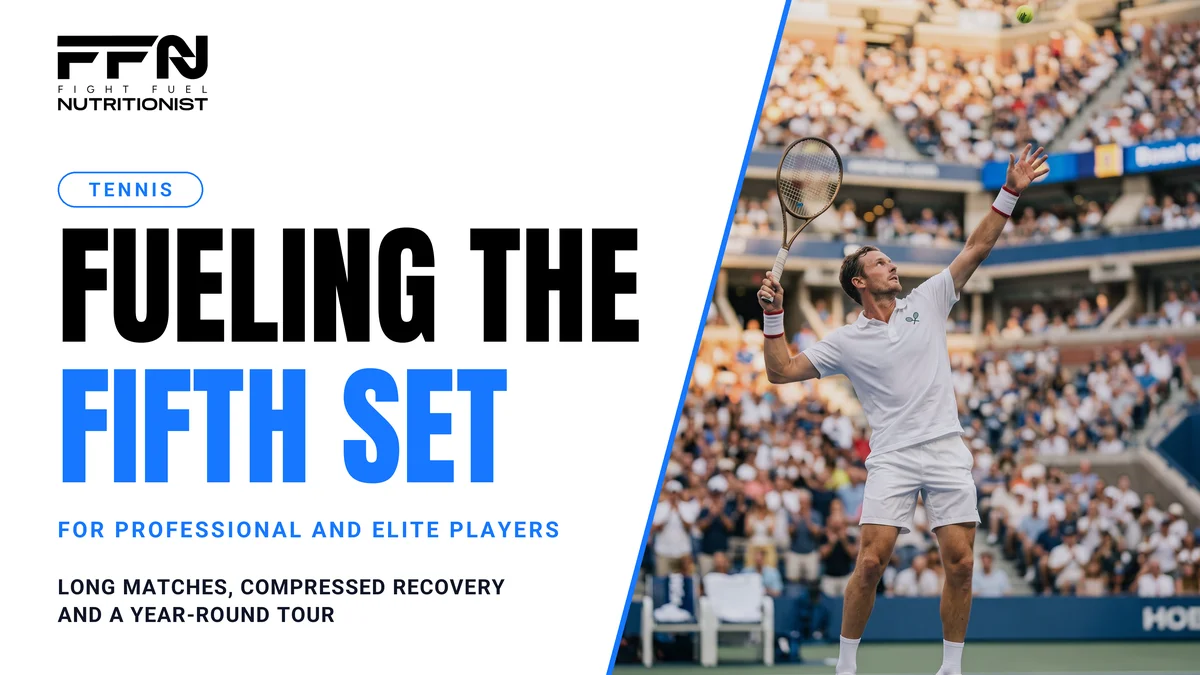
Fueling, hydration, recovery, and back-to-back match management for professional and elite tennis
A tennis match can last 90 minutes or five hours. The player cannot know which it will be when they walk on court. Specifically, a professional singles match combines repeated high-intensity efforts, explosive lateral movement, and constant decision-making — and the length depends on factors largely outside the player’s control. Moreover, the next match may be 24 hours later. Sometimes the same day, if singles and doubles are both on the schedule.
This combination — unpredictable match length, compressed recovery windows, and the demand of a year-round tour — is genuinely unique to tennis. No other major sport requires the same combination of explosive efforts, long durations, individual responsibility (no team bench to absorb load), and same-day or next-day return to competition.
However, most nutrition advice available to tennis players comes from either endurance sport, which does not account for the explosive nature of the game, or team sport, which does not account for the back-to-back demands carried by the individual player. As a result, generic frameworks rarely fit the specific demands of professional tennis.
At the professional level, nutrition must support match performance, recovery between matches in short windows, back-to-back match readiness, training quality, and long-term availability across a punishing tour schedule. This article establishes the foundation for a series on sports nutrition for professional tennis players. Specifically, it covers the real demands of the sport, the variables that matter most, and what an evidence-based approach looks like at the elite level.
Table of Contents
ToggleKey Points
- Professional tennis combines repeated high-intensity efforts with long match durations and high mental load
- Elite matches can last 90 minutes to over five hours, producing high energy demand and significant fluid losses
- Back-to-back matches — sometimes singles and doubles in the same day, or matches on consecutive days — create unique nutritional demands
- Carbohydrate availability directly drives performance in long matches, particularly in the third, fourth, or fifth set
- Hydration demands vary significantly by court surface, climate, and playing style
- Recovery between matches — often 24 hours or less — is a critical and often compressed nutritional window
- Body composition affects movement efficiency, power, and injury resilience
- Travel across time zones, tournament stacking, and surface changes create cumulative recovery challenges
- Sustained performance across a tennis career depends on managing nutrition as a year-round process
Why Tennis Is More Demanding Than Most Frameworks Account For
The physical load of a singles match
A professional singles match combines repeated sprints, explosive lateral movements, sudden accelerations and decelerations, and prolonged low-intensity recovery between points. Specifically, a player may hit between 500 and 1,000 shots in a long match, each one requiring precise movement, timing, and decision-making. Moreover, the intermittent nature of the sport — bursts of maximal effort followed by 20 to 25 second rest periods — creates a specific fueling and hydration profile that neither endurance nor team sport frameworks capture.
The unpredictable length of competition
In addition, match duration is unpredictable. A player can win in 90 minutes or be on court for five hours in extreme heat. Therefore, fueling strategies must prepare for both scenarios, and the player must execute them without gut problems or energy crashes at any stage.
The mental load on top
However, the physical load is only part of the picture. Specifically, tennis is one of the most mentally demanding sports in professional sport. Every point requires reading an opponent’s serve, anticipating ball trajectory, choosing a shot, and executing it under pressure. Over hundreds of points per match, across multiple matches per tournament, the mental demand is enormous. As a result, mental fatigue — not just physical fatigue — often determines who wins deep into long matches.
Key Takeaway
✔ Tennis combines repeated high-intensity efforts, long duration, and high mental load in a way few sports replicate. Therefore, the nutritional demands are specific, substantial, and often underestimated.
The Problem: Generic Frameworks Do Not Fit Tennis
Most nutrition advice available to professional tennis players draws from either endurance sport or team sport. However, neither translates cleanly.
Why endurance frameworks fall short
Endurance frameworks emphasize sustained aerobic work and uniform fueling. While carbohydrate availability is critical in tennis, the explosive, intermittent nature of the game, the match-to-match recovery demands, and the importance of lean mass and power make endurance-style approaches incomplete.
Why team sport frameworks also miss the mark
Team sport frameworks emphasize match-day periodization and recovery between weekly matches. Specifically, tennis players often play consecutive days during tournaments, sometimes after five-hour matches the previous night. As a result, the recovery windows available to team sport athletes simply do not exist on the tour.
Specific challenges for tennis players
- Fueling for unpredictable match durations, from 90 minutes to five hours
- Replacing substantial sodium and fluid losses during matches in heat and humidity
- Recovering fully within 24 hours before the next match
- Managing back-to-back matches, including same-day singles and doubles
- Maintaining body composition while managing irregular schedules and constant travel
- Adapting to surface changes, climate shifts, and time zones across consecutive tournaments
- Sustaining performance across a 10 to 11 month season with few extended breaks
Key Takeaway
✔ Endurance and team sport nutrition frameworks do not cover the specific demands of professional tennis. Therefore, tennis players require a sport-specific approach built around match length variability, back-to-back demands, and tour-long sustainability.
The Solution: The Six Areas That Actually Matter
An evidence-based approach to nutrition for professional tennis players must address six core areas. Moreover, each will be covered in depth in future articles in this series.
Match-day fueling
Match-day nutrition is not about a single pre-match meal. Specifically, it is a sequence of decisions beginning 24 hours before match time and continuing through the match itself. Pre-match meal timing, carbohydrate availability, hydration status, and in-match fueling all contribute to the player’s capacity to sustain high-intensity output and mental sharpness across a match that could last anywhere from 90 minutes to five hours.
Hydration
Hydration in tennis is often the most demanding variable. Sweat losses in hard-court matches in hot conditions can exceed 2 liters per hour, with substantial sodium losses in heavy sweaters. Specifically, a five-set match in high heat and humidity can produce fluid and sodium losses that, if not addressed, directly cause cramping, mental decline, and performance collapse in the later stages.
Recovery between matches
Recovery between matches is one of the most compressed and critical windows in professional sport. Specifically, players often finish late, travel between courts or sites, sleep poorly, and return to the court within 24 hours. Moreover, during Grand Slam tournaments, the best-of-five format compounds the recovery demand. Therefore, refilling glycogen (your body’s stored carbohydrate), fluid and electrolyte replacement, protein intake, and sleep-supporting nutrition all intersect in this window.
Back-to-back match management
Back-to-back matches are a defining feature of professional tennis. Specifically, players regularly face same-day singles and doubles matches, late-night finishes followed by next-morning starts, and consecutive deep tournament rounds with little physical respite. Moreover, these scenarios present nutritional challenges that no other major sport encounters at the same intensity.
When two matches occur on the same day, the player must:
- Refuel and rehydrate quickly between matches without overloading the gut
- Manage carbohydrate and fluid replacement with limited recovery time
- Avoid foods that cause gut problems before returning to court
- Maintain stable blood sugar to support mental sharpness across both matches
When matches occur on consecutive days after long efforts, the priority shifts to maximizing the limited recovery window:
- Aggressive carbohydrate intake within the first hours after the match
- Adequate protein at multiple points across the recovery window
- Deliberate fluid and sodium replacement, with sodium prioritized in heavy sweaters
- Sleep-supporting nutrition to protect overnight recovery
- A pre-match meal the next day that delivers fuel without overloading a recovering gut
Therefore, back-to-back match management is its own discipline, distinct from single match preparation. Moreover, players who handle it well sustain deep tournament runs. Players who do not, fade.
Body composition and power
Tennis is a sport of power applied with precision. Specifically, lean mass, relative strength, and power-to-weight ratio directly influence serve speed, first-step acceleration, and injury resilience. Therefore, nutrition supports body composition goals across the year — both during development and throughout a career where players must maintain physical condition across long tours.
Travel, tournaments, and tour management
Finally, professional tennis is a constant travel sport. Players move between continents, climates, surfaces, and time zones with few breaks. As a result, jet lag, irregular sleep, and disrupted eating patterns create cumulative fatigue across a season. Moreover, nutrition strategies during travel and tournament weeks — targeted carbohydrate intake, recovery nutrition, hydration, and sleep-supporting nutrition — can meaningfully influence whether a player maintains form or fades across a swing.
Key Takeaway
✔ Sports nutrition for professional tennis players must address match-day fueling, hydration, recovery between matches, back-to-back match management, body composition, and tour management. Moreover, each requires a sport-specific approach built around the actual demands of elite tennis.
Practical Application: What This Looks Like at the Elite Level
At the professional level, nutrition for tennis is not a match-day tactic. Instead, it is a year-round process managed across training blocks, tournament weeks, travel, and recovery periods.
Day-to-day nutrition
First, the foundation is consistent daily nutrition that supports training adaptations, body composition, and baseline energy availability. Moreover, the training week should be structured around training load — heavy training days require higher carbohydrate intake, lighter days require adjusted intake — and nutrition should reflect that.
Pre-match nutrition
Second, the hours leading into a match are focused on maximizing carbohydrate availability, ensuring adequate hydration, and avoiding gut problems. Specifically, meal timing depends on match time, which in tennis can vary significantly day to day. Therefore, players benefit from flexible, tested routines rather than rigid protocols.
In-match nutrition
Third, changeovers are the main in-match nutrition opportunity. Specifically, carbohydrate and fluid intake during changeovers can influence performance in the third set onwards, particularly in matches that extend past two hours. Moreover, in hot conditions or during best-of-five matches, deliberate in-match fueling and sodium intake become essential, not optional.
Between matches on the same day
Fourth, when same-day singles and doubles or back-to-back commitments occur, the priority is rapid, tolerable refueling. Specifically, easily digested carbohydrate sources, moderate protein, and aggressive fluid and sodium replacement should begin immediately after the first match. Moreover, the gap between matches dictates the strategy — a 60-minute window calls for liquid and easily digestible options, while a longer window allows more substantial food.
Post-match recovery
Fifth, after the day’s last match, recovery nutrition begins within the first 30 to 60 minutes and continues across the following hours. Protein, carbohydrate, fluid, and electrolyte replacement are the foundation of next-match readiness. In addition, sleep-supporting nutrition becomes important, especially after late-finish matches.
Travel and tournament management
Finally, nutrition strategies during travel and tournament weeks support sleep quality, immune function, and recovery. Specifically, these are the periods where small nutritional gains translate into the largest performance benefits across a multi-week swing.
| Focus Area | Core Principle |
|---|---|
| Daily nutrition | Training-week structure, body composition support |
| Pre-match | Carbohydrate availability, hydration, practical tolerance |
| In-match | Changeover fueling, fluid and sodium replacement |
| Between same-day matches | Rapid, tolerable refueling and rehydration |
| Post-match | Recovery nutrition for the next match |
| Travel and tournaments | Sleep support, immune function, targeted recovery |
Key Takeaway
✔ Nutrition for professional tennis is a year-round process across the training week, match day, between-match windows, and tour calendar. Moreover, the foundation is consistency, with match-specific, back-to-back, and travel-specific adjustments layered on top.
Conclusion
Professional tennis is a sport that rewards sustained performance across long matches, compressed recovery windows, back-to-back demands, and a punishing global tour. Specifically, the nutritional demands are real, specific, and consequential — and they are routinely underestimated, even at the professional level.
Moreover, the tennis players who perform at the highest level across long careers are not always the most naturally gifted. Instead, they are often the ones who treat nutrition, hydration, recovery, sleep, and travel with the same seriousness as the work they do on court.
This article establishes the foundation. Moreover, future articles in this series will go deeper into match-day fueling, hydration protocols, recovery nutrition, back-to-back match management, body composition, travel nutrition, and supplements for the touring professional.
At the elite level, nutrition is not an optional extra. Instead, it is a core part of performance that affects every match, every recovery, and every tour.
Key Takeaway
✔ Sports nutrition for professional tennis players is a sport-specific discipline built on the actual demands of the game — repeated high-intensity efforts, long matches, compressed recovery, back-to-back competition, and constant travel. Therefore, treating it seriously is one of the clearest ways an elite tennis player can extend their career and perform consistently at the highest level.
References
- Vicente-Salar N, Crespo Celda M, Pluim BM, Fernández-Fernández J, Stroia K, Ellenbecker T, Sanz D, Del Coso J, et al. (2025). International Tennis Federation (ITF), Women’s Tennis Association (WTA), and Association of Tennis Professionals (ATP) Expert Group Statement on Nutrition in High-Performance Tennis. Current Evidence to Inform Practical Recommendations and Guide Future Research. International Journal of Sport Nutrition and Exercise Metabolism, 35(6), 557–594.
- Ranchordas MK, Rogersion D, Ruddock A, Killer SC, Winter EM. (2013). Nutrition for tennis: practical recommendations. Journal of Sports Science and Medicine, 12(2), 211–224.
- Kovacs MS. (2007). Tennis physiology: training the competitive athlete. Sports Medicine, 37(3), 189–198.
- Fernandez-Fernandez J, Sanz-Rivas D, Mendez-Villanueva A. (2009). A review of the activity profile and physiological demands of tennis match play. Strength and Conditioning Journal, 31(4), 15–26.
- Bergeron MF. (2003). Heat cramps: fluid and electrolyte challenges during tennis in the heat. Journal of Science and Medicine in Sport, 6(1), 19–27.
- Hornery DJ, Farrow D, Mujika I, Young W. (2007). Fatigue in tennis: mechanisms of fatigue and effect on performance. Sports Medicine, 37(3), 199–212.
- Periard JD, Racinais S, Knez WL, et al. (2014). Coping with heat stress during match-play tennis: does an individualised hydration regimen enhance performance and recovery? British Journal of Sports Medicine, 48(Suppl 1), i64–i70.
- Bergeron MF, Maresh CM, Armstrong LE, et al. (1995). Fluid-electrolyte balance associated with tennis match play in a hot environment. International Journal of Sport Nutrition, 5(3), 180–193.
- Kovacs MS. (2006). Hydration and temperature in tennis — a practical review. Journal of Sports Science and Medicine, 5(1), 1–9.
- Thomas DT, Erdman KA, Burke LM. (2016). Position of the Academy of Nutrition and Dietetics, Dietitians of Canada, and the American College of Sports Medicine: Nutrition and athletic performance. Journal of the Academy of Nutrition and Dietetics, 116(3), 501–528.


