
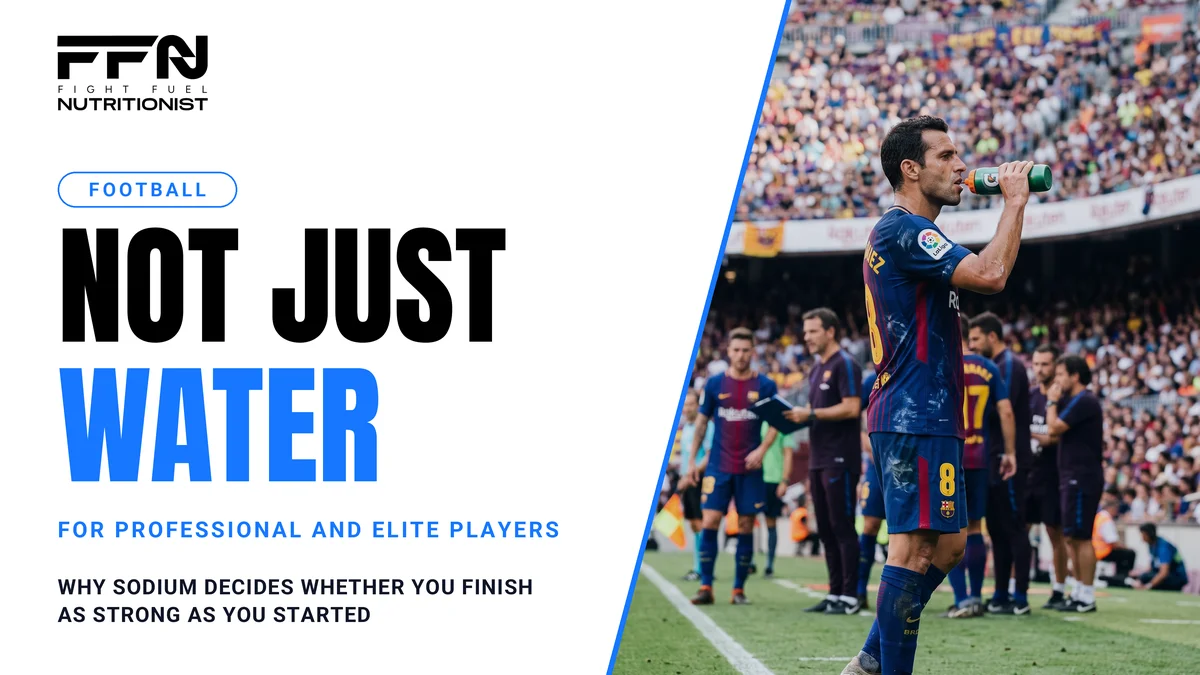
Hydration is one of the most underestimated variables in professional football. The difference between a player who is sharp in the 85th minute and one who fades in the 70th is often not fitness or talent. Instead, it is hydration status going into the match and the decisions made about fluid and sodium replacement during it.
A footballer can lose 1 to 2 liters of fluid in a 90-minute match, sometimes more in heat or humidity, with substantial sodium loss in heavy sweaters. Moreover, even a fluid deficit of 2% of body mass measurably impairs sprint performance, technical execution, and decision-making. Therefore, hydration and sodium replacement during matches must be treated as a structured strategy, not an afterthought.
This article covers what happens to fluid and electrolyte balance across a match, why sodium is as important as fluid, and the practical protocols elite footballers use to stay sharp from the first whistle to the last.
Key Points
- Footballers typically lose 1 to 2 liters of fluid per match, with substantial individual variability
- A fluid deficit as small as 2% of body mass impairs sprint performance, decision-making, and skill execution
- Sodium losses vary widely between players — heavy sweaters and salty sweaters require more deliberate replacement
- Pre-match hydration status determines how the player starts, and there is no shortcut to fix it on the bench
- Half-time is the primary in-match opportunity to refuel and rehydrate
- Sodium during prolonged matches helps maintain blood volume and sustain performance
- Drinking too much plain water can cause hyponatremia (dangerously low blood sodium), particularly in long, hot matches
- Hydration strategies must be personalized based on sweat rate, sodium losses, and match conditions
Why Hydration Decides Second-Half Performance
Fluid loss builds across the match
A footballer’s fluid losses begin during the warm-up and continue through both halves. Sweat rates of 1.0 to 1.5 liters per hour are typical in temperate conditions, with rates exceeding 2 liters per hour in hot, humid environments. As a result, even a player who arrives at the match well-hydrated can finish at a meaningful deficit if in-match replacement is inadequate.
Performance impairment begins early
The effects of fluid loss show up before the player feels thirsty. Fluid deficits as small as 2% of body mass — roughly 1.5 kg in a 75 kg player — measurably impair sprint speed, decision accuracy, technical execution, and tactical awareness. By the time thirst becomes obvious, performance has already declined.
Sodium and blood volume
Sodium loss compounds the problem. This electrolyte drives fluid retention. As sodium leaves the body in sweat, the ability to hold onto consumed fluid decreases. Moreover, blood volume — the liquid component of blood that carries oxygen and nutrients to working muscles — drops faster when sodium is not replaced.
The risk of overcorrection
Drinking too much plain water during long matches in hot conditions can cause hyponatremia (dangerously low blood sodium) — a serious problem that impairs performance and, in severe cases, requires medical attention. Therefore, hydration is not just about volume. It is about the right combination of fluid and sodium for the individual player and the match conditions.
Key Takeaway
✔ Fluid loss and sodium loss build across a match and impair performance before the player feels thirsty. Therefore, hydration during matches requires both fluid and sodium replacement, planned around individual needs.
Pre-Match Hydration: The Foundation
A player who arrives at kick-off well-hydrated has options across the match. A player who arrives at a deficit does not.
Hydration in the 24 hours before the match
Hydration begins the day before, not in the locker room. Consistent fluid and sodium intake across the 24 hours leading into the match builds a baseline that supports performance from the opening whistle.
Practical principles:
- Drink fluids consistently throughout the day, not in large amounts right before the match
- Include sodium with meals — heavy sweaters in particular benefit from deliberately salted foods
- Monitor urine color in the hours before the match — pale yellow indicates adequate hydration
- Avoid excessive caffeine or alcohol the day before, both of which can impair hydration status
Pre-match meal and fluid timing
The pre-match meal — typically 3 to 4 hours before kick-off — should include adequate fluid alongside carbohydrate and protein. Extra fluid intake in the 1 to 2 hours before the match should be moderate and timed to allow for bathroom visits before the warm-up.
The warm-up window
The warm-up itself produces fluid loss that should not be ignored. Drinking 200 to 400 mL of fluid with sodium in the 15 to 30 minutes before kick-off can offset warm-up sweat loss without causing fullness.
Key Takeaway
✔ Pre-match hydration is built across the 24 hours before kick-off, not in the locker room. Therefore, a well-hydrated player at the first whistle is the result of consistent intake leading up to the match.
In-Match Hydration: Working With What the Game Allows
Football offers limited in-match hydration opportunities. Fluid intake must happen during natural stoppages, drinks breaks where allowed, and at half-time — the single largest opportunity available.
During the first half
Within the run of play, opportunities to drink are short and inconsistent. Taking advantage of every available moment matters — corner kicks, set pieces, fouls, and stoppages provide brief windows to take small amounts of fluid.
In hot conditions, league rules in many competitions now require cooling breaks. When temperature and humidity exceed defined thresholds, a structured drinks break around the 30th minute of each half allows meaningful fluid and sodium intake. Players should use these breaks deliberately, not casually.
Half-time: the primary intervention point
Half-time is the most important hydration window of the match. The 15-minute break allows players to consume meaningful volumes of fluid and sodium, refuel with carbohydrate, and prepare physically for the second half.
Practical guidelines for half-time:
- 300 to 600 mL of fluid containing sodium, depending on first-half sweat losses and conditions
- Carbohydrate intake — 30 to 60 grams — to support second-half output
- Avoid large volumes of plain water, particularly in long matches or hot conditions
- Heavy sweaters and salty sweaters should consume sodium-fortified options, not just standard sports drinks
During the second half
Like the first half, in-match opportunities during the second half are limited. The half-time intake must be planned to carry the player through to the final whistle, with smaller top-ups taken during natural stoppages.
Key Takeaway
✔ Half-time is the primary in-match hydration window. Therefore, a deliberate combination of fluid, sodium, and carbohydrate at half-time directly supports second-half performance.
Sodium: When Standard Sports Drinks Are Not Enough
Most commercial sports drinks contain 400 to 700 mg of sodium per liter. For many players in moderate conditions, this is adequate. However, for heavy sweaters or salty sweaters, particularly in heat, this falls short.
Identifying high sodium losers
Several practical markers suggest a player loses more sodium than average:
- Visible white salt residue on skin, kit, or hair after matches
- Persistent cramping in the second half despite adequate fluid intake
- A history of cramping in hot conditions
- Sweat sodium testing has confirmed elevated concentrations
Sodium-fortified options
For these players, deliberate sodium-fortified drinks, sodium tablets, or salty foods at half-time provide more sodium than standard sports drinks. Doses can range from 600 to 1,500 mg or more across the half-time break for the heaviest sodium losers.
Practical considerations
Sodium intake should be tested in training before being used in competition. Gut tolerance varies between players, and unfamiliar concentrations can cause gut problems at the worst possible moment.
Key Takeaway
✔ Heavy sweaters and salty sweaters require more sodium than standard sports drinks provide. Therefore, personalized sodium replacement — tested in training first — is essential for these players.
Hot Weather Matches: A Different Strategy
Matches in heat and humidity demand a more aggressive hydration approach. Sweat losses can double, sodium losses rise proportionally, and the effects of inadequate replacement appear faster.
Key strategies for hot weather matches:
- Pre-match hyperhydration with sodium can support starting blood volume
- Cooling break opportunities should be used for substantial fluid and sodium intake
- Half-time intake should be at the upper end of recommended ranges
- Cold drinks may have a small extra benefit through perceived cooling
- Individual sweat rate should guide the strategy — generic protocols underestimate the demand for some players
Moreover, in tournaments played in extreme heat, recovery hydration between matches becomes as important as in-match replacement. Therefore, the strategy extends beyond the 90 minutes.
Key Takeaway
✔ Hot weather matches require more aggressive hydration and sodium replacement than temperate matches. Therefore, the strategy must scale with the conditions and the individual player.
Avoiding Overhydration and Hyponatremia
While dehydration is the more common problem, overhydration is the more dangerous one. Hyponatremia occurs when athletes consume large volumes of plain water without adequate sodium replacement.
The risk is highest in:
- Long matches in hot conditions
- Players who drink defensively without measuring losses
- Conservative drinkers who suddenly overcorrect
- Players relying on plain water rather than electrolyte drinks during prolonged efforts
Therefore, the hydration strategy must include sodium, especially during long matches in challenging conditions. Moreover, the goal is balance — replacing what is actually lost, not drinking as much as possible.
Key Takeaway
✔ Hyponatremia is rare but dangerous. Therefore, hydration during matches must include sodium, and players should drink to a plan rather than to maximum tolerance.
Conclusion
Hydration and sodium replacement during matches are among the most actionable, evidence-based variables in professional football. The players who arrive well-hydrated, replace fluid and sodium deliberately at half-time, and adapt their strategy to conditions regularly outperform those who treat hydration as an afterthought.
Pre-match hydration determines how a player starts. Half-time replacement determines how they finish. Personalizing the approach — based on sweat rate, sweat sodium concentration, and match conditions — is what separates a generic protocol from an effective one.
At the elite level, hydration is not optional preparation. It is one of the highest-leverage decisions a player makes on match day.
This article covers in-match hydration. Moreover, the foundation hydration article and the post-match recovery article complete the framework, with future articles in the football series addressing match-day fueling, congested fixture management, and tournament hydration.
Key Takeaway
✔ Hydration and sodium replacement during matches are personalized strategies built around sweat rate, sodium losses, and match conditions. Therefore, planning, testing, and individualizing the protocol is one of the clearest ways an elite footballer can sustain performance for the full 90 minutes.
References
- Collins J, Maughan RJ, Gleeson M, et al. (2021). UEFA expert group statement on nutrition in elite football. British Journal of Sports Medicine, 55(8), 416.
- Shirreffs SM, Sawka MN. (2011). Hydration and fluid replacement. Journal of Sports Sciences, 29(Suppl 1), S39–S46.
- Maughan RJ, Watson P, Evans GH, Broad N, Shirreffs SM. (2007). Water balance and salt losses in competitive football. International Journal of Sport Nutrition and Exercise Metabolism, 17(6), 583–594.
- Mohr M, Krustrup P, Bangsbo J. (2003). Match performance of high-standard soccer players with special reference to development of fatigue. Journal of Sports Sciences, 21(7), 519–528.
- Sawka MN, Burke LM, Eichner ER, et al. (2007). Exercise and fluid replacement. Medicine and Science in Sports and Exercise, 39(2), 377–390.
- Baker LB. (2017). Sweating rate and sweat sodium concentration in athletes: a review of methodology and intra/interindividual variability. Sports Medicine, 47(Suppl 1), 111–128.
- Hew-Butler T, Rosner MH, Fowkes-Godek S, et al. (2015). Statement of the 3rd International Exercise-Associated Hyponatremia Consensus Development Conference, Carlsbad, California, 2015. Clinical Journal of Sport Medicine, 25(4), 303–320.
- Mohr M, Mujika I, Santisteban J, et al. (2010). Examination of fatigue development in elite soccer in a hot environment: a multi-experimental approach. Scandinavian Journal of Medicine and Science in Sports, 20(Suppl 3), 125–132.
- Racinais S, Alonso JM, Coutts AJ, et al. (2015). Consensus recommendations on training and competing in the heat. Scandinavian Journal of Medicine and Science in Sports, 25(Suppl 1), 6–19.
- Thomas DT, Erdman KA, Burke LM. (2016). Position of the Academy of Nutrition and Dietetics, Dietitians of Canada, and the American College of Sports Medicine: Nutrition and athletic performance. Journal of the Academy of Nutrition and Dietetics, 116(3), 501–528.


