
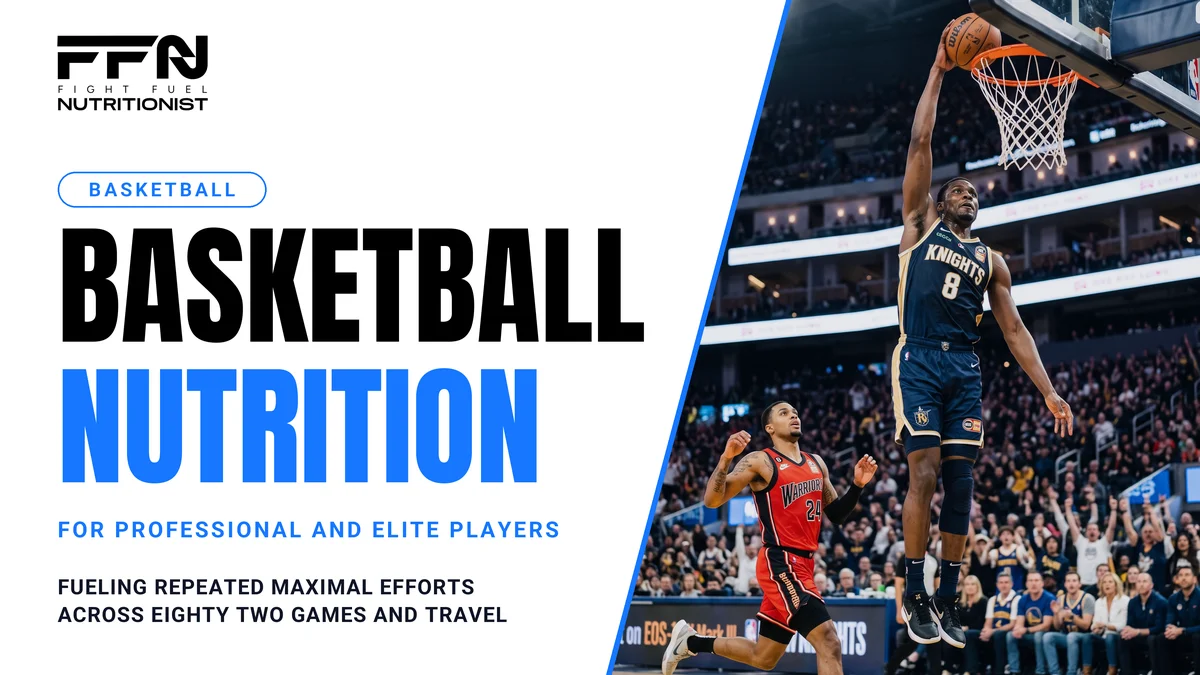
Fueling, hydration, recovery, and back-to-back game management for professional and elite basketball
Basketball is built on repeated maximal efforts. Specifically, an NBA or EuroLeague game combines explosive sprints, jumps with hard landings, and constant change of direction across 40 to 48 minutes — and players do this 70 to 82 times across a regular season, often on consecutive nights. Moreover, the work-to-rest pattern is one of the most demanding in team sport. Plays last 10 to 30 seconds at high to maximal intensity, separated only by short rests during free throws, time-outs, and dead balls.
Most basketball players know nutrition matters. However, the way nutrition is typically taught — borrowed from endurance sport on one side and strength sport on the other — does not match what basketball actually demands. Specifically, neither framework accounts for the explosive, repeat-effort profile of the game, the recovery window between back-to-back nights, or the cumulative load of an 80+ game season with constant travel.
At the professional level, nutrition must support game performance, training quality, recovery between games in compressed windows, body composition for power and durability, and long-term availability across a long, travel-heavy season. This article establishes the foundation for a series on sports nutrition for professional basketball players. Specifically, it covers the real demands of the sport, the variables that matter most, and what an evidence-based approach looks like at the elite level.
Key Points
- Basketball is built on repeated maximal efforts — explosive sprints, jumps with hard landings, and constant change of direction across 40 to 48 minutes
- Players cover 3 to 5 km per game, with 50 to 100 high-intensity actions and 40 to 60 jumps per game
- Stored carbohydrate in the muscles directly drives high-intensity output, jumping power, and skill execution in the second half and overtime
- Hydration demands vary by position, playing style, and arena conditions, with sodium losses meaningful in heavy sweaters
- Recovery between games — often 24 to 48 hours, sometimes back-to-back nights — is one of the most compressed nutritional windows in professional sport
- Body composition affects vertical jump, sprint speed, agility, and injury resilience — nutrition plays a central role
- Travel across time zones, irregular tip-offs, and dense schedules create cumulative recovery challenges
- Sustained performance across an 80-game season plus playoffs depends on managing nutrition as a year-round process, not a game-day tactic
Why Basketball Is More Demanding Than Most Frameworks Account For
The physical load of a basketball game
A professional basketball player covers between 3 and 5 km during a game. However, the headline distance is not the full story. Within that distance sits an average of 50 to 100 high-intensity actions — sprints, accelerations, decelerations, jumps, and direction changes. Specifically, players make roughly 40 to 60 jumps per game, with hard impact forces on each landing. Each of these actions relies on rapid energy provision from glycogen (your body’s stored carbohydrate), and each produces meaningful fatigue.
Moreover, the work-to-rest ratio in basketball is one of the most demanding in team sport. Specifically, plays last 10 to 30 seconds at high to maximal intensity, separated by short rests during free throws, time-outs, and dead balls. As a result, players do not get the sustained low-intensity recovery periods that footballers do across 90 minutes — instead, they cycle between maximal effort and brief incomplete recovery for the entire game.
Mental load on top of physical load
In addition, basketball is a decision-making sport. Specifically, every possession requires reading defenders, choosing between options, executing under contact, and adapting in real time. Over 80 to 100 possessions per game, across multiple games per week, the mental demand is enormous. Therefore, mental fatigue and physical fatigue compound across the game, and the closing minutes of a tight contest are where nutritional preparation made days and hours earlier either supports performance or limits it.
The cumulative load of a season
Furthermore, none of this happens in isolation. A typical professional season includes 70 to 82 regular-season games, multiple back-to-back nights, frequent road trips across time zones, deep playoff runs for top teams, and a training load designed to maintain peak physical condition across 8 to 9 months. As a result, the cumulative demand on nutrition, hydration, recovery, and sleep is among the highest in professional sport.
Key Takeaway
✔ Basketball combines repeated maximal efforts, explosive jumping, high mental load, and a dense schedule with frequent back-to-back games. Therefore, nutritional demands are real, specific, and cumulative across the season.
The Problem: Generic Frameworks Do Not Fit Basketball
Most nutrition advice available to professional basketball players draws from either endurance sport or strength sport. However, neither translates cleanly to the demands of the modern game.
Why endurance frameworks fall short
Endurance frameworks emphasize sustained aerobic work and uniform fueling strategies. While carbohydrate availability is critical in basketball, the explosive, intermittent nature of the game, the importance of jumping power, and the demands of repeated sprints make endurance-style approaches incomplete.
Why strength frameworks also miss the mark
Strength and power frameworks emphasize protein, muscle mass, and recovery from short, hard efforts. Parts of this apply — particularly for jumping power, sprint speed, and injury resilience. However, strength-focused nutrition does not address the high aerobic demand of a 40-minute game, the glycogen depletion across back-to-back nights, or the specific challenges of recovery within 24 hours before the next game.
Specific challenges for basketball players
- Optimizing carbohydrate availability for repeated high-intensity efforts across a full game
- Managing hydration in arenas where conditions vary widely
- Recovering fully within 24 hours before back-to-back games
- Supporting lean mass and jumping power without compromising mobility or endurance
- Adapting to travel, time zone changes, and irregular tip-off times
- Sustaining performance across an 80+ game season without accumulating fatigue
Key Takeaway
✔ Endurance and strength nutrition frameworks do not fully cover the demands of professional basketball. Therefore, basketball players need a sport-specific approach built around game intensity, back-to-back recovery, and season-long performance.
The Solution: The Six Areas That Actually Matter
An evidence-based approach to nutrition for professional basketball players must address six core areas. Each will be covered in depth in future articles in this series.
Game-day fueling
Game-day nutrition is not just about what is eaten immediately before tip-off. Specifically, it is a sequence of decisions beginning the day before the game and ending at the final buzzer. Pre-game meal timing, carbohydrate availability, hydration status, and in-game fueling all contribute to a player’s capacity to sustain high-intensity output across 40 to 48 minutes, particularly in the second half and closing minutes.
Hydration
Hydration in basketball is often underestimated because indoor play feels less hot than outdoor sport. However, sweat losses during a game commonly reach 1 to 2 liters, with meaningful sodium loss in heavy sweaters. Specifically, arena conditions vary widely — some venues run hot and humid, others run cool — and individual sweat rate and sodium concentration drive a player’s actual needs. As a result, individualization based on position, playing style, and venue is essential.
Recovery between games
The window between games — often 24 to 48 hours, sometimes less during back-to-backs — is one of the most critical nutritional periods in basketball. Specifically, refilling glycogen stores, supporting muscle repair and rebuilding, replacing fluid and electrolytes, and sleep-supporting nutrition all intersect in this window. Moreover, recovery nutrition done poorly means the next game starts at a deficit — and across an 82-game schedule, those deficits accumulate.
Body composition and power
Vertical jump, sprint speed, and power-to-weight ratio directly drive game performance and injury resilience. Therefore, nutrition supports body composition goals across the season — both for guards who require sustained sprinting and explosive first-step acceleration, and for forwards and centers whose demands include sustained jumping and physical contact in the paint.
Back-to-back game management
Back-to-back games are a defining feature of professional basketball. Specifically, players regularly face game days separated by less than 24 hours, often with travel between cities in between. Moreover, these scenarios present nutritional challenges that require structured recovery protocols rather than generic post-game routines.
When games occur on consecutive nights, the priority is rapid, complete refueling and hydration:
- Aggressive carbohydrate intake within the first hours after the game
- Adequate protein at multiple points across the recovery window
- Deliberate fluid and sodium replacement, with sodium prioritized in heavy sweaters
- Sleep-supporting nutrition to protect overnight recovery
- A pre-game meal the next day that delivers fuel without overloading a recovering gut
Therefore, back-to-back game management is its own discipline, distinct from single-game preparation.
Travel and season management
Finally, professional basketball is a constant travel sport. Players move between cities, climates, and time zones with few breaks across the regular season. As a result, jet lag, irregular sleep, and disrupted eating patterns create cumulative fatigue. Moreover, nutrition strategies during travel and road trips — targeted carbohydrate intake, recovery nutrition, hydration, and sleep-supporting nutrition — can meaningfully shape whether a player maintains form or fades across a long swing.
Key Takeaway
✔ Sports nutrition for professional basketball players must address game-day fueling, hydration, recovery between games, body composition, back-to-back management, and travel. Moreover, each requires a sport-specific approach built around the actual demands of elite basketball.
Practical Application: What This Looks Like at the Elite Level
At the professional level, nutrition for basketball is not a game-day tactic. Instead, it is a year-round process managed across training camp, the regular season, the playoffs, and travel.
Day-to-day nutrition
First, the foundation is consistent daily nutrition that supports training adaptations, body composition, and baseline energy availability. Moreover, the training week should be structured around training load — heavier practice days require higher carbohydrate intake, lighter days require adjusted intake — and nutrition should reflect that.
Pre-game nutrition
Second, the day before a game and the game day itself are focused on maximizing carbohydrate availability, ensuring adequate hydration, and avoiding gut problems. Specifically, meal timing depends on tip-off time, which can vary from afternoon to late evening across the schedule. Therefore, the goal is consistent: arrive at tip-off fueled, hydrated, and feeling light.
In-game nutrition
Third, in-game nutrition opportunities are short but real. Specifically, time-outs, quarter breaks, and halftime all provide windows for fluid, sodium, and carbohydrate intake. Moreover, in long games or during high-output performances, deliberate in-game fueling can influence fourth-quarter and overtime performance.
Post-game recovery
Fourth, recovery nutrition begins within the first 30 to 60 minutes after the final buzzer and continues across the following 24 to 48 hours. Protein, carbohydrate, fluid, and electrolyte replacement in the hours after a game are the foundation of next-game readiness. In addition, sleep-supporting nutrition becomes important, especially after late-finish road games.
Travel and back-to-back periods
Finally, nutrition strategies during travel and back-to-back game windows support sleep quality, immune function, and recovery. Specifically, these are the periods where small nutritional gains translate into the largest performance benefits across an 80-game season.
| Focus Area | Core Principle |
|---|---|
| Daily nutrition | Training-week structure, body composition support |
| Pre-game | Carbohydrate availability, hydration, practical tolerance |
| In-game | Time-out and halftime fueling, fluid replacement |
| Post-game | Recovery window — carbohydrate, protein, fluid |
| Back-to-back games | Rapid, complete refueling and rehydration |
| Travel and road trips | Sleep support, immune function, targeted recovery |
Key Takeaway
✔ Nutrition for professional basketball is a continuous process across the training week, game day, recovery window, and season. Moreover, the foundation is consistency, with game-specific, back-to-back, and travel-specific adjustments layered on top.
Conclusion
Professional basketball is a sport that rewards sustained performance across a long season of dense competition, high physical demand, and constant travel. The nutritional demands are real, specific, and consequential — and they are often underestimated or managed with frameworks that do not fit the actual demands of the modern game.
The basketball players who perform at the highest level across long careers are not always the most naturally gifted. Instead, they are often the ones who treat nutrition, hydration, recovery, and sleep with the same seriousness as training and tactical preparation.
This article establishes the foundation. Moreover, future articles in this series will go deeper into game-day fueling, hydration protocols, recovery nutrition, body composition for basketball players, back-to-back game management, travel nutrition, and supplements for the professional game.
At the elite level, nutrition is not an optional extra. Instead, it is a core part of performance that affects every game, every recovery, and every season.
Key Takeaway
✔ Sports nutrition for professional basketball players is a sport-specific discipline built on the actual demands of the game — repeated maximal efforts, explosive jumping, dense competition, and constant travel. Therefore, treating it seriously is one of the clearest ways an elite basketball player can extend their career and perform consistently at the highest level.
References
- Schoenfeld BJ, Aragon AA. (2018). How much protein can the body use in a single meal for muscle-building? Implications for daily protein distribution. Journal of the International Society of Sports Nutrition, 15, 10.
- Thomas DT, Erdman KA, Burke LM. (2016). Position of the Academy of Nutrition and Dietetics, Dietitians of Canada, and the American College of Sports Medicine: Nutrition and athletic performance. Journal of the Academy of Nutrition and Dietetics, 116(3), 501–528.
- Burke LM, Hawley JA, Wong SH, Jeukendrup AE. (2011). Carbohydrates for training and competition. Journal of Sports Sciences, 29(Suppl 1), S17–S27.
- Sawka MN, Burke LM, Eichner ER, et al. (2007). Exercise and fluid replacement. Medicine and Science in Sports and Exercise, 39(2), 377–390.
- Mah CD, Mah KE, Kezirian EJ, Dement WC. (2011). The effects of sleep extension on the athletic performance of collegiate basketball players. Sleep, 34(7), 943–950.
- Stojanović E, Stojiljković N, Scanlan AT, Dalbo VJ, Berkelmans DM, Milanović Z. (2018). The activity demands and physiological responses encountered during basketball match-play: a systematic review. Sports Medicine, 48(1), 111–135.
- Ranchordas MK, Dawson JT, Russell M. (2017). Practical nutritional recovery strategies for elite soccer players when limited time separates repeated matches. Journal of the International Society of Sports Nutrition, 14, 35.
- Williams C, Rollo I. (2015). Carbohydrate nutrition and team sport performance. Sports Medicine, 45(Suppl 1), S13–S22.
- Nédélec M, McCall A, Carling C, Legall F, Berthoin S, Dupont G. (2013). Recovery in soccer: part II — recovery strategies. Sports Medicine, 43(1), 9–22.
- Baker LB. (2017). Sweating rate and sweat sodium concentration in athletes: a review of methodology and intra/interindividual variability. Sports Medicine, 47(Suppl 1), 111–128.


