
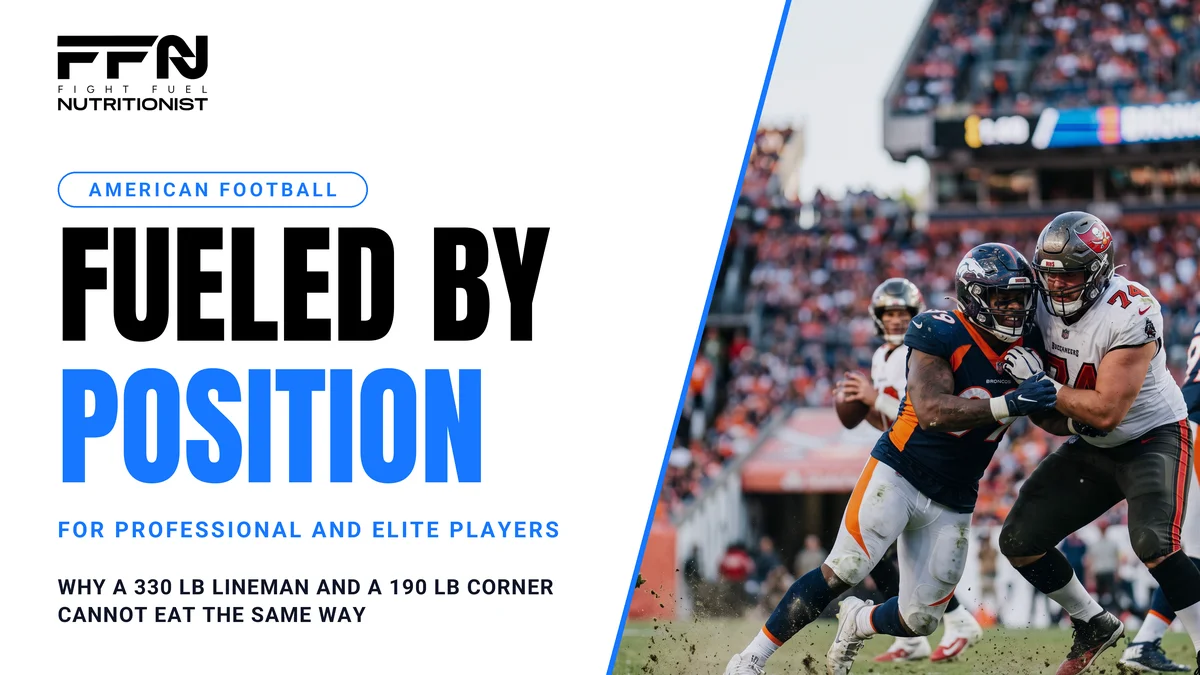
Position-specific fueling, hydration, body composition, and recovery for professional and elite American Football
American football is built around position-specific extremes. Specifically, a professional roster includes players who range from 185 lb cornerbacks to 330+ lb offensive linemen — all performing at elite level on the same field, on the same play, with completely different physical demands. Moreover, no other major team sport has this body composition spread, and no other team sport places such different demands on the players who share a roster.
As a result, the most important variable in American football nutrition is not the sport itself. Instead, it is the position. Specifically, what works for a wide receiver does not work for a defensive tackle. What a quarterback needs to maintain across a 17-game season looks nothing like what a starting guard needs. Therefore, generic team-sport nutrition advice — built around an average player who does not exist in this league — fails American football harder than almost any other sport.
For professional and elite American football players, nutrition must support the demands of a specific position, the body composition that position requires, the collision load across a long season, and the recovery between games (which can range from a normal seven-day window to a four-day Thursday Night turnaround). Furthermore, all of this happens on top of a brutal preseason, training camp in heat with full pads, and the build-up of a 17-game schedule plus playoffs.
This article establishes the foundation for a series on sports nutrition for professional American football players. Specifically, it covers what makes the sport distinctive, why position is the central variable, and what an evidence-based approach looks like at the elite level.
Key Points
- American football is defined by position-specific extremes, with player body weights ranging from 185 lb to 330+ lb on the same roster
- Position determines almost every nutritional variable — energy needs, body composition targets, hydration demands, recovery priorities, and supplement needs
- The play-based structure of the game (4 to 7 second plays separated by 30 to 40 second rests) creates a unique work-to-rest pattern with high single-play intensity and long total game duration
- Hydration losses can be extreme, particularly for linemen in full pads in hot conditions, with sweat rates among the highest in professional sport
- Body composition directly drives performance and is position-specific — linemen require mass and strength, skill positions require lean speed and agility
- The 17-game regular season, plus preseason, playoffs, and Super Bowl, creates one of the largest total collision loads in professional sport
- Recovery between games is usually 7 days, but short-week games (Thursday Night Football) and travel across time zones create compressed recovery windows
- Off-season and preseason nutrition often involve body composition adjustments — linemen building or maintaining mass, skill positions cutting body fat — and these cycles must be managed carefully
- Concussion and collision risk make brain health and managing inflammation particularly relevant for American football players
Why American Football Is Different From Most Team Sports
Position is the central variable
In most team sports, players across positions have broadly similar physical profiles. For example, footballers, basketball players, and rugby players show variation across positions, but the spread is modest compared to American football. Specifically, a center in basketball might weigh 50 lb more than a guard. However, a center in football can weigh 140 lb more than a cornerback.
As a result, American football nutrition cannot be built around “the average player.” There is no average player. Instead, there are linemen, skill positions, and specialists, and each group has fundamentally different needs:
- Offensive and defensive linemen — typically 290 to 340+ lb, requiring mass for blocking and run defense, with very high total energy needs and the highest sweat rates on the team
- Linebackers and tight ends — typically 240 to 270 lb, balancing size with speed and the ability to cover ground
- Running backs and quarterbacks — typically 200 to 230 lb, requiring staying healthy under contact, explosive power, and the ability to make decisions across four quarters
- Wide receivers, defensive backs, and specialists — typically 180 to 220 lb, requiring lean speed, agility, and the ability to repeat maximal sprints
The same nutrition plan cannot serve all of these players. For example, a 330 lb offensive tackle eating like a 190 lb cornerback will lose mass and lose his job. Similarly, a cornerback eating like a tackle will lose speed and lose his job. As a result, position-specific nutrition is not a refinement at the elite level — it is the foundation.
The play-based structure of the game
American football is also structured very differently from sports played continuously. Specifically, plays last 4 to 7 seconds, separated by 30 to 40 seconds of rest, with longer breaks between possessions, between quarters, and at halftime. As a result, total game time stretches over three to three-and-a-half hours, but actual play time is around 11 to 12 minutes of football across that window.
This structure means each play can be performed at near-maximal intensity — explosive starts, hard collisions, short maximal sprints — but the total volume of high-intensity work per player varies enormously by position. For example, a starting offensive lineman may participate in 60 to 70 plays per game with collision contact on most of them. A starting wide receiver may run 20 to 30 high-speed routes. A specialist may play 10 to 15 plays. Therefore, each profile has different fueling, hydration, and recovery demands.
The collision load
What sets American football apart from most other team sports is the collision component. Specifically, every play involves contact, and many involve high-impact collisions between large athletes moving at speed. Across a 17-game season plus preseason and playoffs, the total collision load is real — and the recovery demands that follow include both standard physical recovery and considerations specific to repeated impact.
Key Takeaway
✔ American football is defined by position-specific extremes and a play-based collision structure unlike most other team sports. Therefore, nutrition must be built around position first, with general principles layered on top — not the other way around.
The Problem: Generic Frameworks Do Not Fit American Football
Most nutrition advice available to American football players draws from either generic team sport nutrition or, at best, frameworks built for other team sports. However, none of these capture what American football actually demands.
Why endurance frameworks miss
Endurance-based frameworks emphasize sustained aerobic work and uniform fueling strategies. However, American football is not an endurance sport. Specifically, the play-based, intermittent maximal effort structure looks nothing like a 90-minute football match or a marathon, and applying endurance carbohydrate-loading or fueling protocols misses what the sport actually requires.
Why strength-only frameworks also miss
Strength and power frameworks address part of the picture — particularly for linemen, where mass, strength, and explosive power are central. However, strength-focused nutrition does not address the high running demands of skill positions, the recovery demands across a long season, or the hydration challenges of training in full pads in heat.
Why “team sport nutrition” misses
Generic team sport nutrition — typically built around football (soccer) or basketball — assumes a relatively uniform athlete profile and a structure of sports played continuously. However, American football has neither. Specifically, the body composition spread, the play-based structure, and the collision load all push the sport outside the standard team sport framework.
Specific challenges for American football players
- Building or maintaining the very high body weights required by linemen without affecting health markers
- Maintaining lean speed and agility for skill positions across a long season
- Managing hydration and sodium losses in pads and helmets, particularly in training camp heat
- Recovering across a 7-day window between most games, with adjustments for short-week games
- Handling the build-up of collision load across 17 regular season games plus playoffs
- Adjusting body composition across the off-season, preseason, and in-season cycles
- Supporting brain health and managing inflammation given the collision profile of the sport
Key Takeaway
✔ Generic team sport, endurance, and strength-only nutrition frameworks do not fit American football. Therefore, players need a sport-specific approach built around position, the play-based structure, the collision load, and the demands of a long season.
The Solution: The Six Areas That Actually Matter
An evidence-based approach to nutrition for professional American football players must address six core areas. Each will be covered in depth in future articles in this series.
Position-specific energy, carbohydrate, protein, and fat needs
The starting point is position. Specifically, a 330 lb offensive lineman may need 5,000 to 7,000 kcal per day to maintain mass during the season, while a 190 lb defensive back may need 3,000 to 3,500 kcal. As a result, carbohydrate, protein, and fat targets all shift accordingly. Moreover, distribution across the day matters — protein delivered across 4 to 6 meals, carbohydrate matched to training and game demands, and total energy supporting body composition goals.
Game-day fueling
Game-day nutrition begins the day before the game and ends at the final whistle. Specifically, the pre-game meal must support a 3+ hour game window, in-game fueling opportunities at quarter breaks and halftime support performance in the second half, and position-specific demands shape what each player needs. For example, a lineman fueling for sustained collision contact has different needs than a quarterback managing decision-making across four quarters.
Hydration
Hydration in American football is one of the most demanding challenges in professional sport. Specifically, players in full pads and helmets — particularly linemen — can lose 4 to 8 lb of fluid in a hot training camp practice, with sodium losses to match. Moreover, dehydration impairs collision performance, decision-making, and recovery. As a result, individualized hydration based on position, sweat rate, and conditions is essential.
Body composition management
Body composition directly drives performance and is position-specific. Specifically, linemen require mass and strength, with body fat managed within ranges that support both performance and long-term health. In contrast, skill positions require lean mass, speed, and agility. Moreover, body composition cycles across the year — off-season build phases, preseason adjustments, and in-season maintenance — and nutrition must be planned across all of them.
Recovery between games
The standard 7-day recovery window between games is generous compared to other team sports — but it is rarely the only schedule. Specifically, Thursday Night Football creates 4-day turnarounds that compress recovery, and Monday Night games shift the entire week. As a result, recovery nutrition — refilling glycogen (your body’s stored carbohydrate), supporting muscle repair and rebuilding, replacing fluids and electrolytes, and managing inflammation from collision contact — has to flex to fit the schedule.
Season management and travel
Finally, the 17-game regular season plus preseason and playoffs creates a long total load. Specifically, travel across time zones, hotel food environments, body composition maintenance across the season, and the build-up of collision contact all shape nutrition strategy. As a result, season management is its own discipline — distinct from week-to-week game preparation.
Key Takeaway
✔ Sports nutrition for professional American football players must address position-specific energy needs, game-day fueling, hydration, body composition, recovery between games, and season management. Moreover, each of these is shaped by position more than by any other variable.
Practical Application: What This Looks Like at the Elite Level
At the professional level, nutrition for American football is a year-round process managed across the off-season, training camp, the regular season, and playoffs.
Off-season
The off-season is where many body composition adjustments happen. Specifically, linemen often gain mass, skill positions often reduce body fat, and all players build the foundation for training camp. Therefore, nutrition in this phase supports strength training, body composition goals, and recovery from the previous season’s collision load.
Training camp and preseason
Training camp brings extreme conditions — long days in full pads in heat, multiple practices, and the highest sweat rates of the year. Specifically, hydration, sodium replacement, energy intake, and recovery between sessions all become acute priorities. Moreover, body composition is often adjusted further during preseason as players hit their season-target weights.
Regular season
During the regular season, the goal shifts to maintenance and game performance. Specifically, weekly nutrition supports practice, recovery, body composition stability, and game-day execution. Moreover, the schedule (standard week, short week, long week, bye week) shapes how each week is structured.
Playoffs and championship runs
Finally, deep playoff runs add weeks to the season and increase the build-up of game-to-game load. Specifically, body composition tends to drift in late season — players often lose weight as the season progresses — and nutrition strategy must adjust to maintain performance and stay healthy into January and February.
| Phase | Nutrition Focus |
|---|---|
| Off-season | Body composition adjustments, recovery from previous season |
| Training camp | Hydration, sodium replacement, energy intake, recovery |
| Regular season | Maintenance, weekly recovery, game-day fueling |
| Short weeks (Thursday games) | Compressed recovery, accelerated refueling |
| Playoffs | Maintain body composition, manage total season load |
Key Takeaway
✔ Nutrition for professional American football is a year-round process with phase-specific priorities — body composition in the off-season, hydration and energy in training camp, maintenance and game-day execution in the regular season, and staying healthy through the playoffs.
Conclusion
Position is the central variable
American football is one of the most position-specific sports in professional team sport. Specifically, no two positions on the field have the same nutritional demands, and no single nutrition plan can serve a roster of players who range from 185 lb to 330+ lb. As a result, position is the central variable in American football nutrition — and any approach that ignores it cannot succeed.
What separates the players who last
The players who perform at the highest level across long careers are not always the most physically gifted. Instead, they are often the ones who understand how their position-specific demands shape their nutrition, hydration, recovery, and body composition decisions — and who manage these variables deliberately across a long season.
Where this series is going
This article establishes the foundation. Furthermore, future articles in this series will go deeper into position-specific energy needs, game-day fueling, hydration in pads and heat, body composition management for linemen and skill positions, recovery between games (including short-week games), and season management.
At the elite level, nutrition is not separate from position. Instead, it is shaped by position in almost every dimension. Therefore, the players who treat their nutrition as position-specific rather than generic gain a meaningful edge in performance, staying healthy, and career length.
Key Takeaway
✔ Sports nutrition for professional American football players is built around position first. Specifically, the body composition spread, the play-based structure, and the collision load make this the most position-specific nutrition challenge in professional team sport. Therefore, treating nutrition as position-specific is one of the clearest ways an elite American football player can extend their career and perform at the highest level.
References
- Thomas DT, Erdman KA, Burke LM. (2016). Position of the Academy of Nutrition and Dietetics, Dietitians of Canada, and the American College of Sports Medicine: Nutrition and athletic performance. Journal of the Academy of Nutrition and Dietetics, 116(3), 501–528.
- Burke LM, Hawley JA, Wong SH, Jeukendrup AE. (2011). Carbohydrates for training and competition. Journal of Sports Sciences, 29(Suppl 1), S17–S27.
- Sawka MN, Burke LM, Eichner ER, et al. (2007). Exercise and fluid replacement. Medicine and Science in Sports and Exercise, 39(2), 377–390.
- Baker LB. (2017). Sweating rate and sweat sodium concentration in athletes: a review of methodology and intra/interindividual variability. Sports Medicine, 47(Suppl 1), 111–128.
- Bosch TA, Burruss TP, Weir NL, et al. (2014). Abdominal body composition differences in NFL football players. Journal of Strength and Conditioning Research, 28(12), 3313–3319.
- Jonnalagadda SS, Rosenbloom CA, Skinner R. (2001). Dietary practices, attitudes, and physiological status of collegiate freshman football players. Journal of Strength and Conditioning Research, 15(4), 507–513.
- Jäger R, Kerksick CM, Campbell BI, et al. (2017). International Society of Sports Nutrition position stand: protein and exercise. Journal of the International Society of Sports Nutrition, 14, 20.
- Gleeson M, Bishop NC, Stensel DJ, et al. (2011). The anti-inflammatory effects of exercise: mechanisms and implications for the prevention and treatment of disease. Nature Reviews Immunology, 11(9), 607–615.
- Mountjoy M, Sundgot-Borgen J, Burke L, et al. (2018). IOC consensus statement on relative energy deficiency in sport (RED-S): 2018 update. British Journal of Sports Medicine, 52(11), 687–697.
- Mihalik JP, Lengas E, Register-Mihalik JK, Oyama S, Begalle RL, Guskiewicz KM. (2013). The effects of sleep quality and sleep quantity on concussion baseline assessment. Clinical Journal of Sport Medicine, 23(5), 343–348.


