
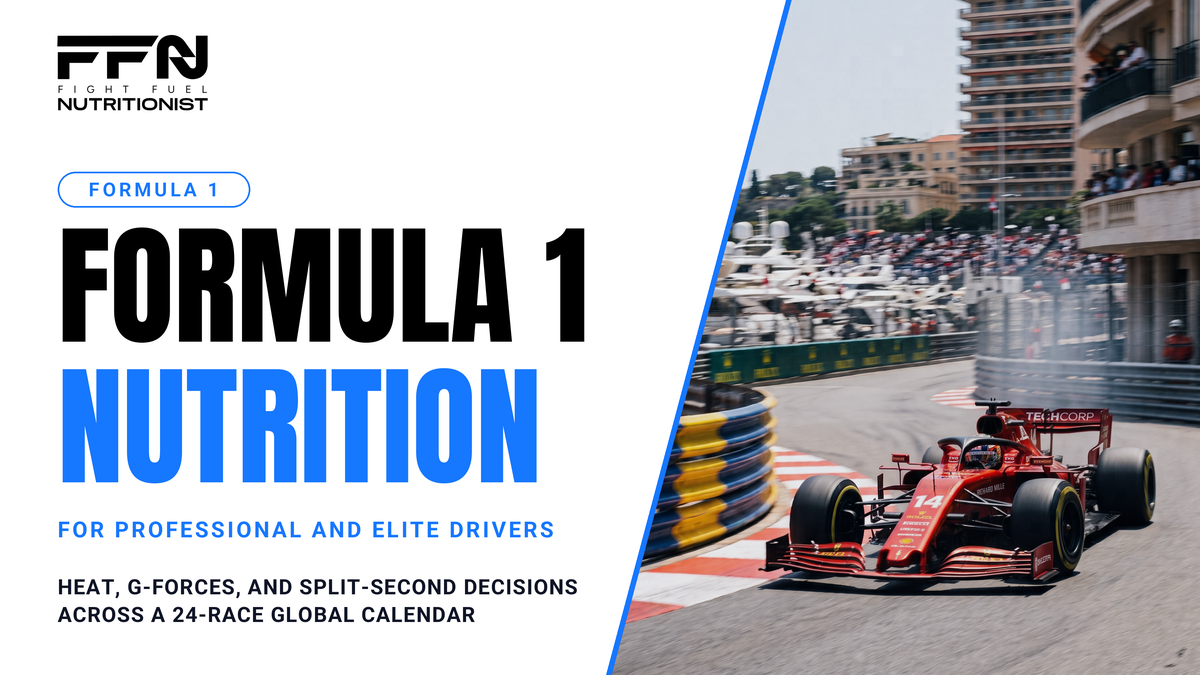
How elite drivers fuel, hydrate, and sharpen mental performance for the unique demands of cockpit heat, G-forces, and split-second decisions
Formula 1 is one of the most misunderstood sports in the world. Specifically, the casual observer sees drivers sitting in a car for 90 minutes and assumes the physical demand must be low. In reality, F1 drivers operate in conditions that combine the cardiovascular load of an endurance athlete, the heat stress of a marathon in the desert, and the cognitive precision of a fighter pilot — all at once, across a 24-race global calendar.
A Grand Prix driver can lose 3 to 4 kg of fluid in a single race, sustain heart rates of 140 to 180 bpm for over 90 minutes, and experience cockpit temperatures of 50 to 60°C. Moreover, the driver must make split-second decisions where out-braking a competitor by one car length at 200 mph equates to a 50-millisecond margin — less than a quarter of the time it takes to blink. Therefore, nutrition for F1 is not just about fueling the body. It is about protecting mental performance, regulating body temperature, and managing recovery across a season that crosses every time zone on the calendar.
This foundation article sets out the unique demands of F1, the core nutrition areas every elite driver must address, and the framework that future articles in the series will build on.
Key Points
- F1 combines endurance-level cardiovascular demand, extreme cockpit heat, sustained G-forces, and cognitive precision in ways no other sport replicates
- Sweat losses of 2 to 4 kg per race are common, with even higher losses in hot races like Singapore, Qatar, and Bahrain
- A fluid deficit as small as 2% of body mass impairs decision-making, reaction time, and attention — the exact skills F1 demands most
- Race weekends span three days of practice, qualifying, and racing, with cumulative nutrition demands that go beyond race day
- Cockpit temperatures reach 50 to 60°C, producing heat stress comparable to endurance sport in extreme climates
- Body composition is tightly managed under minimum car-plus-driver weight rules, requiring careful body composition strategy
- Mental performance support — through hydration, blood sugar stability, and evidence-based caffeine use — is as important as physical fueling
- A global 24-race calendar means travel and body clock adjustment are core nutrition concerns, not afterthoughts
What Makes Formula 1 Different
A combined endurance and cognitive sport
Few sports demand both endurance-level physical output and split-second cognitive precision at the same time. Specifically, F1 demands both for 90 to 120 minutes per race, in extreme heat, while the driver makes thousands of decisions about braking points, racing lines, tire management, and competitor positioning.
Cockpit conditions
The F1 cockpit is one of the most physically demanding environments in sport. Specifically, cockpit temperatures regularly reach 50 to 60°C during races. Drivers wear multi-layered fireproof suits, helmets, and head and neck restraints that block heat loss. As a result, the body must work hard to cool itself across the entire race — and sweat losses scale accordingly.
G-forces
Sustained lateral and longitudinal G-forces of 3 to 5G are common throughout a race, with peaks of up to 6G under heavy braking and high-speed cornering. Therefore, neck, core, and upper-body strength must be high enough to keep the head stable and the body anchored — and the cardiovascular system must handle the load of sustaining position under repeated G-load.
Race weekend structure
Unlike most sports, an F1 race is not a single event. Specifically, a typical Grand Prix weekend includes:
- Friday — two practice sessions, often in race conditions
- Saturday — final practice and qualifying
- Sunday — the race itself
- Sprint weekends — sprint qualifying and a sprint race add to the load
As a result, the driver must perform at a high level across three days, with limited recovery time between sessions. Therefore, nutrition decisions across the full weekend matter — not just race-day fueling.
A global calendar
The modern F1 season includes around 24 races across five continents. Specifically, drivers cross multiple time zones almost every two weeks during the season. As a result, travel nutrition, sleep management, and body clock adjustment are core nutrition concerns, not optional extras.
Key Takeaway
✔ F1 is unique in combining endurance-level cardiovascular demand, extreme cockpit heat, G-forces, cognitive precision, and a global calendar. Therefore, nutrition must serve all of these demands at once.
The Physiological Demands
Cardiovascular load
Average heart rates of 140 to 180 bpm for the full race duration are typical, with peaks of 200 bpm under high stress. As a result, the cardiovascular load over 90 to 120 minutes is comparable to a long endurance event — not a passive driving exercise.
Heat stress
Combined cockpit heat, fireproof clothing, and physical exertion produce significant heat stress. Specifically, sweat losses of 2 to 2.5 liters per hour are common, with total race losses of 3 to 4 kg in hot races. As a result, fluid and sodium replacement strategy is one of the most important parts of race-day nutrition.
Cognitive demand
The mental load of F1 is extreme. Specifically, drivers process visual information at speeds approaching 300 km/h, manage multiple steering wheel inputs, track tire degradation, communicate with the pit wall, and execute racing lines within centimeters. Therefore, anything that impairs mental performance — dehydration, low blood sugar, fatigue, poor sleep — translates directly into slower decisions and more errors.
Energy demand
A typical race burns 1,500 to 2,000 calories. Specifically, the combination of sustained cardiovascular load, isometric muscle work to resist G-forces, and the body’s cooling effort drives energy expenditure higher than the seated position suggests. As a result, race-day fueling must support both physical and mental performance across the full race weekend, not just the 90 minutes on Sunday.
Key Takeaway
✔ The physiological demands of F1 combine endurance-level cardiovascular load, extreme heat stress, high cognitive demand, and meaningful energy expenditure. Therefore, the nutrition strategy must support all four at once.
The Core Nutrition Areas
Energy availability
F1 drivers need enough total energy intake to support training, race weekends, and recovery across a long season. Specifically, chronic under-fueling for body composition reasons — a real risk in a sport with strict weight rules — impairs mental performance, recovery, and immune function. Therefore, energy availability must be matched to the actual demand of each phase of the season.
Hydration and sodium
Hydration is the highest-leverage nutrition variable in F1. Specifically, given sweat losses of 2 to 4 kg per race and the well-known effects of 2% dehydration on decision-making and reaction time, a driver who arrives at the start grid in even mild fluid deficit is already at a disadvantage. Moreover, sodium replacement matters as much as fluid replacement, particularly for heavy sweaters and salty sweaters in hot races.
Carbohydrate fueling
Carbohydrate availability supports both physical performance and mental performance during long sessions. Specifically, stable blood sugar across practice, qualifying, and race sessions reduces mental fatigue and protects decision-making in the final laps. Therefore, race-day carbohydrate strategy is as much about brain fuel as muscle fuel.
Mental performance support
Several evidence-based tools support mental performance in F1: stable blood sugar, full hydration, structured caffeine use at the right doses and timing, and adequate sleep across the race weekend. Specifically, caffeine has the strongest evidence base of any legal supplement for attention, reaction time, and decision-making under fatigue — exactly the demands F1 places on its drivers.
Body composition under weight rules
F1 sets a minimum combined weight for car and driver. Therefore, drivers must manage body composition carefully — typically lean and light, but not so under-fueled that performance, recovery, or health suffer. As a result, body composition strategy in F1 sits at the intersection of performance, regulation, and long-term health.
Recovery between sessions
The three-day race weekend means recovery between sessions matters as much as race-day fueling. Specifically, the 4 Rs of recovery — refuel with carbohydrate, rehydrate with fluid and sodium, repair with protein, and recuperate with sleep — apply between each session, not just at the end of the race.
Travel and the global calendar
Crossing multiple time zones every two weeks during the season makes travel nutrition a core competency for F1 drivers. Specifically, hydration during flights, meal timing on destination time, light exposure on arrival, and sleep management all shape how the driver performs across a back-to-back race calendar.
Key Takeaway
✔ The core nutrition areas for F1 are energy availability, hydration and sodium, carbohydrate fueling, mental performance support, body composition under weight rules, recovery between sessions, and travel nutrition. Therefore, a complete F1 nutrition strategy is built across all seven areas, not focused on any one.
The Race Weekend Framework
Friday: practice
Friday’s two practice sessions set the tone for the weekend. Specifically, full hydration, balanced fueling, and adequate sleep going into Friday support the driver’s ability to learn the car, tire behavior, and track conditions across the day.
Saturday: qualifying
Saturday adds final practice and qualifying. Specifically, qualifying is a short, high-intensity effort where mental performance and reaction time matter most. Therefore, careful pre-qualifying fueling, hydration, and caffeine timing support the lap that defines the driver’s race-day starting position.
Sunday: race
The race itself is the longest, hottest, and most demanding session. Specifically, race-day nutrition includes pre-race meal timing, in-car hydration strategy, sodium replacement, and post-race recovery — covered in detail in future articles in this series.
Post-race recovery
Recovery between races matters more in a back-to-back calendar than in any other elite sport. Specifically, the 4 Rs of recovery start immediately after the race and continue through the travel day to the next race location.
Key Takeaway
✔ The F1 race weekend is a three-day performance event, with nutrition demands across practice, qualifying, race, and recovery. Therefore, planning across the full weekend — not just race day — is what separates the drivers who sustain performance across a season from those who fade.
Common Mistakes F1 Drivers Make
Under-fueling for body composition
Chronic under-fueling to make weight is one of the most common errors in F1. Specifically, the cost shows up in mental performance, recovery, and immune function across the season — exactly the areas drivers can least afford to compromise.
Relying on a single race-day hydration strategy
Hydration must be built across the 24 hours before the race, not in the hour before lights out. Specifically, drivers who arrive at the grid at even mild fluid deficit lose performance from the first lap.
Treating practice and qualifying as low-importance
Practice and qualifying nutrition often gets less attention than race-day fueling. Specifically, given that qualifying determines race position and practice sets tire and car setup, the cost of poor nutrition across Friday and Saturday is significant.
Ignoring travel nutrition
A 24-race global calendar makes travel one of the highest-leverage nutrition areas. Specifically, drivers who treat travel as passive transit rather than active preparation pay the cost in arrival readiness, sleep quality, and recovery between races.
Key Takeaway
✔ The most common F1 nutrition errors are chronic under-fueling, last-minute hydration, neglecting practice and qualifying, and ignoring travel nutrition. Therefore, professional drivers benefit from a structured framework that addresses each area across the full season.
Practical Application: A Complete F1 Nutrition Framework
A complete framework for elite F1 drivers combines six core elements:
- Match energy availability to the demands of each phase — training, race weekends, recovery, and travel
- Build hydration as a 24-hour practice, not a race-day task
- Plan carbohydrate fueling around mental performance as well as physical demand
- Use evidence-based mental performance tools — caffeine, sleep, blood sugar stability — at the right doses and timing
- Manage body composition strategically within weight rules, without compromising performance or health
- Treat travel nutrition as a core part of the season, not an optional add-on
Key Takeaway
✔ A complete F1 nutrition strategy combines energy, hydration, carbohydrate, mental performance support, body composition management, and travel nutrition. Therefore, the framework is built around the full season, not just race day.
Conclusion
Formula 1 is a sport unlike any other. Specifically, it asks its athletes to be endurance athletes, heat-acclimatized performers, and split-second decision-makers all at once — across a global calendar that crosses every time zone in the world. Therefore, nutrition for F1 is not a single subject. It is a complete framework that supports physical performance, mental performance, recovery, and long-term health across a long, demanding season.
This foundation article sets out the principles. Specifically, future articles in the F1 series will cover race-day hydration and sodium strategy, hot-race protocols (Singapore, Qatar, Bahrain), mental performance and caffeine use for drivers, body composition under weight rules, recovery between sessions and races, and travel nutrition for the global calendar.
At the elite level, the drivers who sustain performance across a 24-race season are not always the most physically gifted. Instead, they are the ones whose nutrition supports every demand of the sport — from the first practice session on Friday to the final post-race recovery meal on Sunday night, and across every flight to the next race.
Key Takeaway
✔ F1 combines endurance, heat, G-forces, and cognitive precision in ways no other sport replicates. Therefore, nutrition for F1 must be a complete framework — covering energy, hydration, fueling, mental performance, body composition, recovery, and travel — built around the demands of the full season.
References
- Mansell C, Rogerson D, Tallent J, et al. (2025). Fine-tuning performance: a systematic review on physical and physiological adaptations and testing in motorsport. Sports Medicine — Open, advance online publication.
- Reid M, Lightfoot J. (2019). The physiology of auto racing. Medicine and Science in Sports and Exercise, 51(12), 2548–2562.
- Barthel S, Ferguson D. (2020). Thermal stress in motorsport: cardiovascular and physiological responses. Journal of Thermal Biology, 93, 102716.
- Hancock PA, Vasmatzidis I. (2003). Effects of heat stress on cognitive performance: the current state of knowledge. International Journal of Hyperthermia, 19(3), 355–372.
- Backman J, Häkkinen K, Ylinen J, Häkkinen A, Kyröläinen H. (2005). Physiological and selective attention demands during an international rally motor sport event. BioMed Research International, 2015, 638659.
- Pingitore A, Mastorci F, Berti S, et al. (2022). Redox implications of extreme task performance: the case in driver athletes. Antioxidants, 11(2), 254.
- Owen N, Watkins J, Kilduff L, Bevan H, Bennett M. (2015). Literature review of race driver fatigue measurement in endurance motorsport. Procedia Engineering, 112, 344–348.
- Lee SR, Jäger R, Kerksick CM, et al. (2025). The influence of Cereboost on mood, cognitive function, and simulated driving in professional race car drivers. Journal of the International Society of Sports Nutrition, 22(1), 2456120.
- Thomas DT, Erdman KA, Burke LM. (2016). Position of the Academy of Nutrition and Dietetics, Dietitians of Canada, and the American College of Sports Medicine: Nutrition and athletic performance. Journal of the Academy of Nutrition and Dietetics, 116(3), 501–528.
- Sawka MN, Burke LM, Eichner ER, et al. (2007). Exercise and fluid replacement. Medicine and Science in Sports and Exercise, 39(2), 377–390.
- Guest NS, VanDusseldorp TA, Nelson MT, et al. (2021). International Society of Sports Nutrition position stand: caffeine and exercise performance. Journal of the International Society of Sports Nutrition, 18(1), 1.
- Bonilla DA, Pérez-Idárraga A, Odriozola-Martínez A, Kreider RB. (2021). The 4R’s framework of nutritional recovery: a guide to improving high-performance athletes. International Journal of Environmental Research and Public Health, 18(1), 103.