
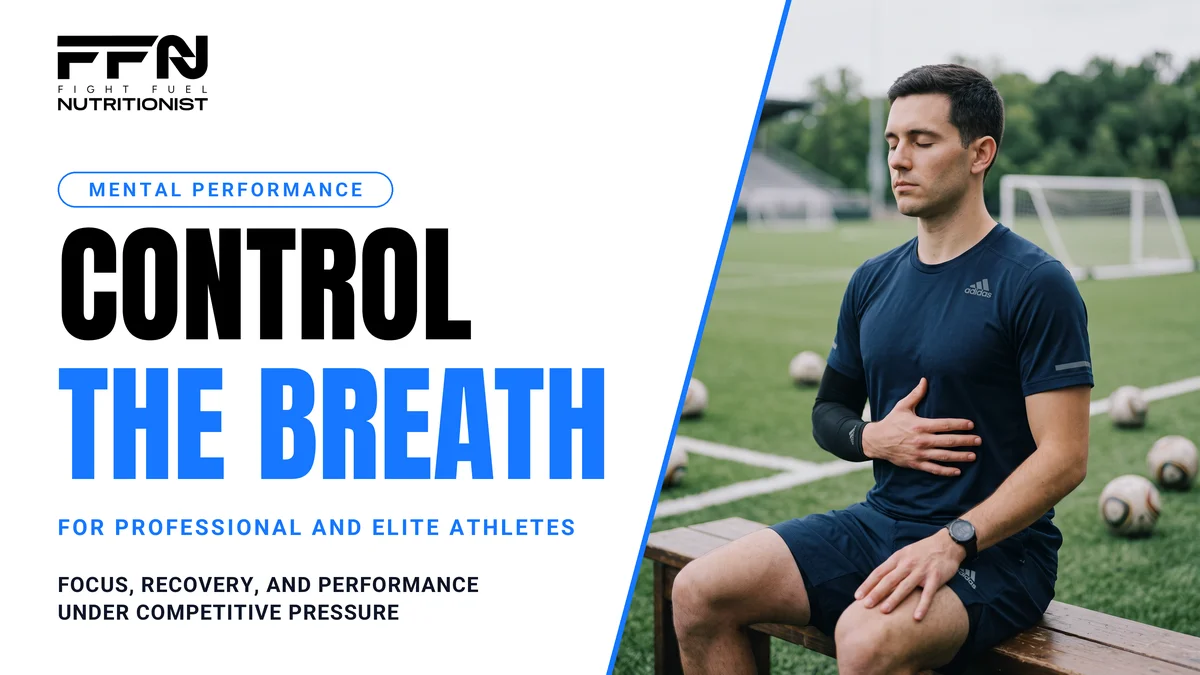
Breathing techniques for focus, recovery, and performance under pressure
Breathing is one of the few automatic functions you can also control deliberately. However, most athletes never use that control. Instead, they let their breathing follow whatever physical and emotional state they happen to be in — fast and shallow under pressure, irregular under fatigue, mouth-dominant during effort.
However, structured breathing techniques can change that. Specifically, they can shift your nervous system, sharpen your focus, regulate your stress response, support recovery, and in some cases directly improve performance. The evidence behind these effects ranges from strong (breathing muscle training, slow-paced breathing for stress regulation) to emerging (Oxygen Advantage-style nasal breathing and CO2 tolerance work) to mechanistically sound but less directly studied in elite sport (box breathing, physiological sighs).
For professional and elite athletes, breathwork is not a magic bullet. However, it is one of the cheapest, most accessible, and most underused tools available — particularly for managing pressure, sharpening focus before competition, and supporting recovery between sessions.
This article covers the techniques with the strongest evidence, what each one actually does, and how to use them in a professional athlete’s week.
Key Points
- Breathing directly influences your nervous system, your stress response, your focus, and in some cases your performance — and it is one of the few automatic functions you can deliberately control
- Slow-paced breathing (around 6 breaths per minute) has strong evidence for activating the calming side of your nervous system, increasing heart rate variability, and reducing anxiety
- Box breathing is widely used in military and elite sport for focus and pressure regulation, with strong mechanistic evidence even where direct sport-specific trials are limited
- The physiological sigh (two inhales through the nose followed by a long exhale through the mouth) is a fast, evidence-supported tool for reducing acute stress
- Nasal breathing improves oxygen uptake, supports nitric oxide release (which helps blood vessels open up), and reduces breathing rate — and the Oxygen Advantage approach builds on this with CO2 tolerance training
- Inspiratory muscle training (training the muscles you use to breathe in) has the strongest direct performance evidence of any breathwork, with consistent improvements in endurance, perceived effort, and breathing muscle strength
- The right technique depends on what you are trying to achieve — focus, recovery, performance, stress regulation — and these can be combined into a structured weekly approach
- Breathwork is not a substitute for training, sleep, or nutrition — but as an add-on tool, it is cheap, accessible, and consistently underused in professional sport
Why Breathing Matters for Performance
How breathing shifts your nervous system
Your nervous system has two main branches that govern your physical and mental state. One branch drives the “fight or flight” response that gears you up for action — elevated heart rate, faster breathing, alertness, tension. The other branch drives the “rest and recover” state — lower heart rate, slower breathing, recovery, calm focus.
Breathing is one of the most direct ways to shift between these states. For example, fast, shallow breathing pushes you toward the action side. In contrast, slow, controlled breathing through the nose pulls you toward the recovery side.
For an athlete, this matters for several reasons:
- Pre-competition arousal that climbs too high impairs technical execution and decision-making
- Post-session activation that does not come down delays recovery
- Sleep onset depends on a shift to the recovery side
- Focus under pressure requires controlled arousal — not too high, not too low
As a result, breathing gives you a deliberate lever on all of these.
CO2 tolerance and breathing efficiency
A second key concept is CO2 tolerance. When CO2 builds up in your blood during effort or breath-holding, it creates the “air hunger” sensation that makes you want to breathe harder.
For most athletes, low CO2 tolerance shows up as breathlessness that arrives earlier than it should, or breathing that feels uncontrolled under pressure. Therefore, training your CO2 tolerance — through nasal breathing, slow exhales, and structured breath-holding — can reduce this sensation and improve breathing efficiency.
Focus and decision-making
Breathing directly influences how clearly you think. Specifically, slow, controlled breathing improves attention, working memory, and emotional control. This matters for any sport requiring tactical decision-making, technical execution under pressure, or sustained mental focus across long sessions.
Key Takeaway
✔ Breathing directly affects your nervous system state, your stress response, your CO2 tolerance, and your focus. As a result, deliberate breathing techniques give athletes a fast, accessible lever on all of them.
Slow-Paced Breathing: The Strongest Evidence Base
What it is
Slow-paced breathing — sometimes called coherent breathing or resonance breathing — involves slowing your breath to around 6 breaths per minute. In practice, this typically looks like a 5-second inhale through the nose and a 5-second exhale through the nose or mouth.
What the evidence shows
This is one of the most studied breathing techniques in human physiology. Specifically, slow-paced breathing at around 6 breaths per minute consistently produces:
- Increased heart rate variability (the variation in time between your heartbeats, and one of the best signs that your nervous system is in a recovery state)
- Reduced cortisol (your main stress hormone) and other stress markers
- Reduced anxiety and improved emotional control
- Improved attention and focus
- Better sleep quality when used pre-bed
The evidence base spans clinical, military, and athletic populations. Furthermore, this is the breathing pattern most often used in heart rate variability training — where you use HRV measurements as real-time feedback.
How to use it as an athlete
Pre-competition stress management. 5 to 10 minutes of slow-paced breathing in the hour before competition can reduce excess arousal without dulling performance readiness.
Post-session recovery. 10 minutes after a hard session can speed the shift into recovery mode, supporting recovery and sleep onset.
Before sleep. 10 minutes of slow-paced breathing in bed reduces sleep onset time and improves sleep quality, particularly during high-stress periods.
Daily practice. 10 to 20 minutes per day, ideally in the morning or evening, builds the underlying capacity over time.
Key Takeaway
✔ Slow-paced breathing (6 breaths per minute) has the strongest evidence base of any breathing technique for nervous system regulation, focus, and stress management. As a result, 5 to 10 minutes pre-competition, post-session, or before sleep produces meaningful effects.
Box Breathing: Focus Under Pressure
What it is
Box breathing follows a four-part rhythm: inhale for 4 seconds, hold for 4 seconds, exhale for 4 seconds, hold for 4 seconds. Specifically, it is simple, easy to learn, and quickly accessible in high-pressure settings.
What the evidence shows
Box breathing is widely used in military settings (notably by US Navy SEALs) and increasingly in professional sport. The direct sport-specific trial evidence is more limited than for slow-paced breathing. However, the underlying mechanism is well-supported — it activates the recovery side of your nervous system, builds CO2 tolerance through the breath-holds, and provides a structured focus point during high-arousal moments.
How to use it as an athlete
In-competition reset. Between points, sets, plays, or rounds — wherever your sport gives you a structured break — 1 to 2 cycles of box breathing can rapidly reset focus and reduce arousal.
Pre-competition focus. 5 minutes in the warm-up area helps establish a controlled, focused state before competition.
During high-pressure moments. Between attempts in skill-based sports (golf, tennis serves, free throws, penalty kicks) box breathing provides a structured pattern that displaces racing thoughts.
The simplicity is part of the value. Specifically, you do not need to learn complex techniques — you need a tool you can use under pressure, and box breathing meets that bar.
Key Takeaway
✔ Box breathing (4-4-4-4) is a simple, structured technique with strong supporting mechanism and widespread use in elite sport and military settings. As a result, it works particularly well as an in-competition reset and during high-pressure moments.
The Physiological Sigh: Fast Stress Reduction
What it is
The physiological sigh involves two inhales through the nose followed by one long exhale through the mouth. Specifically, the second inhale is shorter than the first, and the exhale is significantly longer than either inhale.
What the evidence shows
The mechanism behind the physiological sigh is well-established. Specifically, the second inhale re-inflates collapsed air sacs in your lungs, and the long exhale produces rapid activation of your nervous system’s recovery side. As a result, the technique has gained widespread attention in elite sport and the broader performance community over the past several years.
A short daily practice of physiological sighing can reduce anxiety and improve mood, with effects that appear faster than other breathing techniques. Therefore, it has earned a place in the practical toolkit of athletes managing in-competition stress.
How to use it as an athlete
Acute stress reduction. When you need to drop arousal quickly — between plays, before a key moment, or after a high-pressure decision — 1 to 3 physiological sighs produce a fast effect.
Mid-session reset. A few physiological sighs during a break can reset your state more quickly than longer techniques.
Daily practice. A few minutes per day can improve stress management over time.
In contrast to box breathing or slow-paced breathing, the physiological sigh works in seconds rather than minutes. As a result, it is one of the most useful tools for in-competition stress management.
Key Takeaway
✔ The physiological sigh (two inhales through the nose, one long exhale through the mouth) is one of the fastest evidence-supported tools for acute stress reduction. Therefore, it suits in-competition moments where you need to drop arousal in seconds.
Nasal Breathing and the Oxygen Advantage Approach
Why nasal breathing matters
Nasal breathing is the foundation of the Oxygen Advantage approach developed by Patrick McKeown, building on the earlier work of Buteyko. Specifically, the basic principle is that most athletes habitually mouth-breathe far more than they should — both at rest and during effort — and that switching to nasal breathing produces multiple benefits.
The evidence supporting nasal breathing includes:
- Improved oxygen uptake through the release of nitric oxide in your nasal passages (nitric oxide helps your blood vessels open up, which improves blood flow and oxygen delivery)
- Better CO2 tolerance and reduced “air hunger” during effort
- Reduced breathing rate and improved breathing efficiency
- Improved sleep quality and reduced snoring/sleep apnea risk
- Better filtering, warming, and adding moisture to the air you breathe in
CO2 tolerance training
The Oxygen Advantage method extends nasal breathing into structured CO2 tolerance training. Specifically, this includes:
- The BOLT score (Body Oxygen Level Test) — a measurement of how long you can hold your breath after a normal exhale before feeling the first urge to breathe. Scores below 20 seconds suggest low CO2 tolerance, while scores above 40 seconds indicate well-trained tolerance
- Breath holds during walking, jogging, or training — structured breath holds during low to moderate intensity efforts to build CO2 tolerance over time
- Reduced breathing during recovery between intervals — keeping breathing rate low and nasal-only between hard efforts
The evidence base, honestly
The direct trial evidence for the Oxygen Advantage approach in elite athletes is more limited than for slow-paced breathing or breathing muscle training. However, the underlying physiology is well-supported, and applied use in professional sport has grown meaningfully. As a result, this is best classified as evidence-supported in principle, with growing applied evidence and ongoing research.
How to use it as an athlete
Switch to nasal breathing as your default. During warm-ups, low and moderate intensity training, recovery between intervals, and at rest. Specifically, only switch to mouth breathing when intensity demands it.
Train your BOLT score. Test it weekly. Furthermore, build it through breath-hold practice and reduced breathing protocols.
Integrate breath holds into training. During easy or moderate sessions, structured nasal breath holds can build CO2 tolerance without compromising the session.
Sleep with mouth taped (where appropriate and safe). This is a common Oxygen Advantage recommendation for habitual mouth breathers, though it should be approached with care and only after consultation with a medical professional if there is any concern about breathing or sleep disorders.
Key Takeaway
✔ Nasal breathing and the Oxygen Advantage approach build on solid physiology, with growing applied use in professional sport. Although the direct trial evidence in elite athletes is more limited than for some other techniques, the principles — defaulting to nasal breathing, training CO2 tolerance, reducing breathing rate — produce meaningful benefits when applied consistently.
Breathing Muscle Training: The Strongest Performance Evidence
What it is
Breathing muscle training — also called inspiratory muscle training (IMT) — involves training the muscles you use to inhale by breathing against resistance. Specifically, the diaphragm and the muscles between your ribs are the main targets, and the most common protocol uses a handheld device (such as POWERbreathe) that provides adjustable inspiratory resistance.
What the evidence shows
IMT has the strongest direct performance evidence of any breathwork technique. Specifically, the evidence consistently shows:
- Improved endurance performance across multiple sports
- Reduced perceived effort at any given workload
- Improved breathing muscle strength and endurance
- Reduced fatigue at the end of long efforts
- Improved repeated-sprint performance in some contexts
The effects are most pronounced in efforts where breathing becomes a limiting factor — endurance events, high-intensity intervals, and sustained efforts at high cardiovascular load.
Standard protocol
The most well-supported protocol is:
- 30 inhales twice per day against resistance set at 50 to 60% of your maximum inhale strength
- 6 days per week, for 4 to 6 weeks to produce measurable adaptations
- Maintenance phase of 30 inhales per day, 3 days per week thereafter
In practice, sessions take 3 to 5 minutes. As a result, the time investment is small for the magnitude of effect.
How to use it as an athlete
IMT is a structured training intervention rather than a state-regulation tool. Therefore, it sits alongside your physical training, not in place of it. The practical considerations are:
- Build it in during the offseason or pre-season for the largest adaptations
- Maintain across the competitive season with the reduced-frequency protocol
- Combine with other breathing techniques (nasal breathing, slow-paced breathing) for a complete approach
- Track progress through repeated maximum inhale strength measurement or BOLT score changes
Key Takeaway
✔ Breathing muscle training has the strongest direct performance evidence of any breathwork technique. Specifically, 4 to 6 weeks of structured training (30 inhales twice daily against resistance) produces meaningful improvements in endurance, perceived effort, and breathing muscle strength.
Practical Application: Building Breathwork Into a Professional Athlete’s Week
Match the technique to the goal
Different breathing techniques serve different purposes. Therefore, the most effective approach is to use the right tool for the right context rather than picking one and applying it everywhere.
| Goal | Best Technique | When to Use |
|---|---|---|
| Reduce pre-competition arousal | Slow-paced breathing (6 bpm) | 5–10 min in warm-up area |
| Reset focus mid-competition | Box breathing or physiological sigh | Between plays, points, attempts |
| Drop acute stress fast | Physiological sigh | Seconds before a key moment |
| Improve recovery between sessions | Slow-paced breathing, nasal breathing | Post-session and during sleep prep |
| Improve breathing efficiency | Nasal breathing, CO2 tolerance work | Throughout training and rest |
| Improve endurance and breathing muscle strength | Breathing muscle training (IMT) | 5 min/day, 4–6 weeks |
A weekly framework
For a professional athlete who wants to integrate breathwork systematically:
Daily:
- Default to nasal breathing during all low and moderate intensity activity
- 10 minutes of slow-paced breathing — morning, before training, or before sleep
- Use physiological sighs as needed throughout the day for acute stress
3 to 6 times per week:
- Breathing muscle training (during the build phase)
- Box breathing during competition or high-pressure training
Pre-competition:
- Slow-paced breathing in the warm-up area
- Box breathing or physiological sighs as in-competition tools
Post-competition:
- Slow-paced breathing for recovery-side activation
- Continued nasal breathing during cool-down
Key Takeaway
✔ A complete breathwork approach uses different techniques for different goals — slow-paced breathing for stress and recovery, box breathing and physiological sighs for in-competition focus, nasal breathing as a default, and breathing muscle training as a structured performance intervention. Therefore, the framework is straightforward to integrate and scales with your training week.
Conclusion
Breathwork is cheap, accessible, and underused
Breathwork is one of the most accessible performance tools available to professional and elite athletes. Specifically, it costs nothing. Furthermore, it requires no equipment beyond an optional breathing muscle training device. As a result, it can be practiced anywhere, applied in real time, and combined with everything else you do.
What the evidence actually supports
The strength of the evidence varies across techniques. Specifically, slow-paced breathing and breathing muscle training have the strongest support. In contrast, box breathing and the physiological sigh are mechanistically sound and increasingly applied in elite settings. Moreover, nasal breathing and the Oxygen Advantage approach build on solid physiology with growing applied evidence.
What separates athletes who use breathwork well
The athletes who get value from breathwork are not the ones who try every technique once and abandon them. Instead, they are the ones who pick the right tools for the right contexts, practice them consistently, and integrate them into their existing training, recovery, and competition routines.
Key Takeaway
✔ Breathwork is not a magic bullet. However, used deliberately and consistently, it is one of the cheapest, most accessible, and most underused performance tools available. Therefore, the athletes who treat it seriously gain a real advantage in focus, stress regulation, recovery, and in some cases direct performance.
References
- Laborde S, Allen MS, Borges U, et al. (2022). Effects of voluntary slow breathing on heart rate and heart rate variability: A systematic review and a meta-analysis. Neuroscience and Biobehavioral Reviews, 138, 104711.
- Balban MY, Neri E, Kogon MM, et al. (2023). Brief structured respiration practices enhance mood and reduce physiological arousal. Cell Reports Medicine, 4(1), 100895.
- Russo MA, Santarelli DM, O’Rourke D. (2017). The physiological effects of slow breathing in the healthy human. Breathe, 13(4), 298–309.
- HajGhanbari B, Yamabayashi C, Buna TR, et al. (2013). Effects of respiratory muscle training on performance in athletes: a systematic review with meta-analyses. Journal of Strength and Conditioning Research, 27(6), 1643–1663.
- Illi SK, Held U, Frank I, Spengler CM. (2012). Effect of respiratory muscle training on exercise performance in healthy individuals: a systematic review and meta-analysis. Sports Medicine, 42(8), 707–724.
- McKeown P, O’Connor-Reina C, Plaza G. (2021). Breathing re-education and phenotypes of sleep apnea: A review. Journal of Clinical Medicine, 10(3), 471.
- Romer LM, McConnell AK. (2003). Specificity and reversibility of inspiratory muscle training. Medicine and Science in Sports and Exercise, 35(2), 237–244.
- Zaccaro A, Piarulli A, Laurino M, et al. (2018). How breath-control can change your life: a systematic review on psycho-physiological correlates of slow breathing. Frontiers in Human Neuroscience, 12, 353.


