
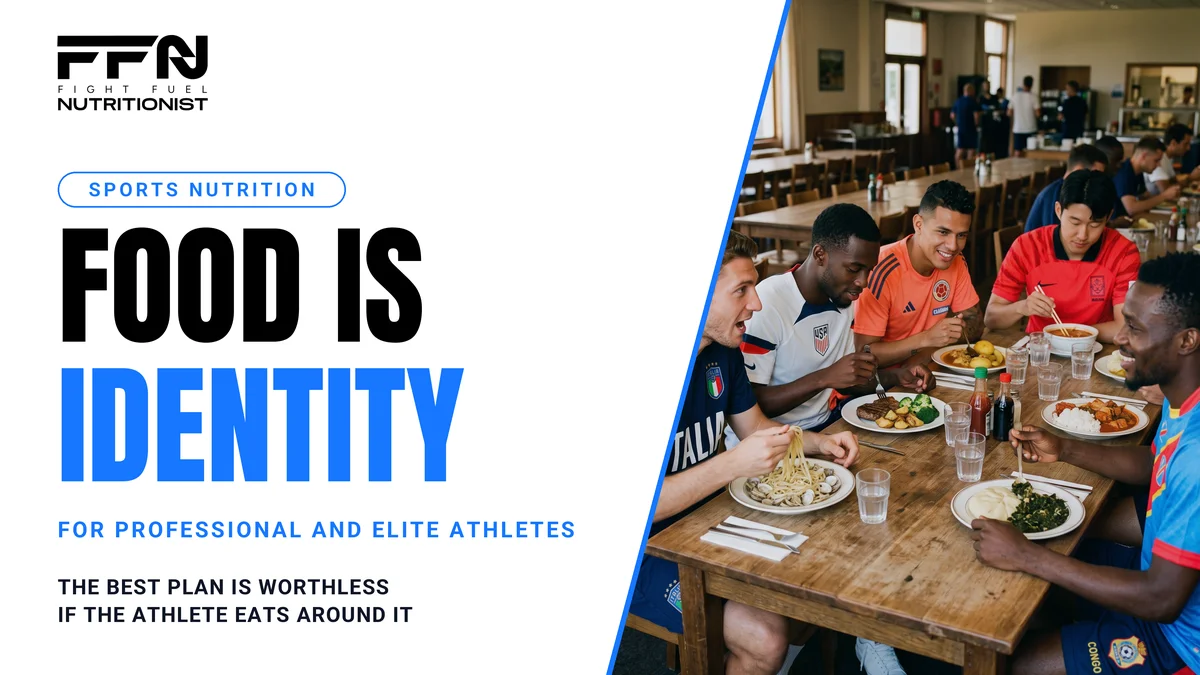
Food culture is the foundation of sports nutrition plans that actually work
Sports nutrition is often presented as a set of universal rules — protein targets, carbohydrate timing, hydration protocols, supplement frameworks. The numbers are real and the evidence is strong. However, none of it works if the athlete cannot or will not eat the food.
Food is not just fuel. It is identity, memory, family, comfort, and culture. For professional and elite athletes — many of whom train and compete far from home, often in countries with different food traditions than their own — the gap between a nutrition plan that looks right on paper and a plan the athlete actually follows is enormous. The difference is rarely about nutrition knowledge. It is about whether the plan respects who the athlete is and where they come from.
For sports dietitians, coaches, and the athletes themselves, this matters more than most performance teams acknowledge. The most evidence-based nutrition plan in the world produces nothing if the athlete eats around it. In contrast, a culturally informed plan that meets the same nutrition targets through familiar, preferred foods produces sustained adherence — and adherence is what actually drives long-term performance.
This article covers why food culture matters in elite sport, the practical issues professional athletes face, and how to build nutrition plans that work in the real world.
- Food is not just fuel — it is identity, memory, family, and culture, and ignoring this in elite sport reduces the effectiveness of any nutrition plan
- Athletes who train and compete far from home often face nutrition plans built around food traditions that are not their own, which reduces adherence
- The same nutrition targets — energy, carbohydrate, protein, vitamins and minerals — can be met through countless cultural food patterns
- Food preferences also shape whether athletes can sustain a nutrition approach across a long season, not just for a week or two
- Rigid, one-size-fits-all nutrition plans tend to fail at the elite level because they ignore the individual athlete’s relationship with food
- A practical, culturally informed approach — built around familiar foods, family meals, and individual preferences — produces better adherence and better long-term outcomes
- For athletes traveling internationally, planning around the food culture of competition destinations is part of the performance strategy
- Supporting an athlete’s food culture is not a soft skill — it is a core part of effective sports nutrition practice
Why Food Culture Matters at the Elite Level
Food carries meaning beyond nutrition
For most athletes, food is tied to home, family, childhood, and identity. The meals an athlete grew up with carry emotional weight that has nothing to do with macronutrients. As a result, replacing those meals with unfamiliar substitutes — even nutritionally equivalent ones — often feels like a loss.
For professional athletes living and training away from home, this matters more, not less:
- Familiar food provides comfort during long, demanding seasons
- Family meals or home-style cooking reduce the psychological load of constant travel
- Cultural food connects athletes to who they are outside of sport
- Eating in line with cultural and religious practices is a non-negotiable for many athletes
Food is not just performance input. It is part of how athletes maintain their identity, mental health, and sense of normality across the demands of elite sport.
The adherence problem
The most well-designed nutrition plan in the world is worthless if the athlete does not follow it. Adherence is the single biggest predictor of whether nutrition support actually translates into performance benefit.
Athletes are more likely to follow nutrition plans that:
- Use foods they recognize and enjoy
- Fit with how their family or community eats
- Respect their cultural and religious practices
- Allow for the meals that matter to them emotionally
- Adapt to the food available where they live and travel
In contrast, plans that demand unfamiliar foods, restrict cultural staples, or treat the athlete as a generic case tend to break down within weeks. As a result, the apparent “discipline” of a strict plan often produces worse long-term outcomes than a more flexible, culturally informed approach.
Key Takeaway
✔ Food carries meaning beyond nutrition — identity, family, comfort, religion. Nutrition plans that ignore this break down over time, while plans that respect it produce better adherence and better long-term performance.
The Real Challenges Professional Athletes Face
Athletes from one culture, training in another
Many professional athletes train and compete in countries different from where they grew up. As a result, the food available to them does not always match the food they want to eat:
- A South American footballer in northern Europe
- A Japanese baseball player in the United States
- An African distance runner in a European altitude camp
- A Middle Eastern combat sports athlete competing in Asia
For these athletes, the practical reality is that the standard nutrition advice from local sports dietitians often points to foods they do not recognize, do not enjoy, or have never eaten. The cultural mismatch is built into the system.
Travel and competition abroad
Professional athletes also face constant travel — preseason camps, away matches, international competitions, training camps in different climates. Every trip involves food that may differ meaningfully from home, in ways that affect both adherence and gut tolerance.
Athletes who plan poorly for this often arrive at competition having eaten unfamiliar food for days, with gut problems, energy fluctuations, and reduced confidence in their fueling. In contrast, athletes who plan deliberately — bringing key foods with them, researching destinations, working with local support — protect their performance.
Religious and cultural practices
For many athletes, food choices are also shaped by religious or cultural practices:
- Fasting during Ramadan for Muslim athletes
- Plant-based eating for athletes following Hindu, Buddhist, or other traditions
- Halal or kosher requirements for Muslim and Jewish athletes
- Cultural taboos around certain foods or food combinations
- Family or community meal patterns that conflict with standard sports nutrition timing
None of these are problems to be solved by overriding the athlete’s beliefs. Instead, they are constraints to be respected and built around. Sports nutrition can support athletes through Ramadan, plant-based eating, and other practices — but only when the practitioner respects the practice itself as non-negotiable.
Family and team meal cultures
Food is often communal. For many athletes, eating with family, with teammates, or in shared meals is part of their daily life. As a result, nutrition plans that demand individual meals, separate timing, or unusual food choices can isolate athletes from these social structures.
Treating nutrition as a purely individual matter ignores the social reality of how most athletes actually eat.
Key Takeaway
✔ Professional athletes face real challenges around food — cultural mismatch when training abroad, constant travel, religious and cultural practices, and the social context of meals. Each of these affects adherence, and each requires a plan that respects the athlete’s actual life rather than fighting against it.
How to Build Culturally Informed Nutrition Plans
Start with the athlete, not the protocol
The first step is understanding what the athlete actually eats — and wants to eat — before building a plan:
- What foods did they grow up with?
- What does their family or community eat?
- What religious or cultural practices shape their food choices?
- What foods do they genuinely enjoy?
- What foods do they dislike or struggle to eat?
Without this information, any plan is generic. With it, the plan can meet performance targets through foods the athlete will actually eat.
Meet the same targets through familiar foods
The major sports nutrition targets — energy, carbohydrate, protein, vitamins and minerals, fluid, sodium — can be met through countless food patterns:
- A high-carbohydrate breakfast can be oats, rice, plantains, tortillas, or noodles
- A high-protein meal can be built around chicken, fish, beef, lentils, beans, paneer, or tofu
- Recovery carbohydrate can come from sports drinks, fruit, white rice, or traditional breads
- Sodium can be replaced through sports drinks, salty foods, or salt added to food
The principles of sports nutrition are universal. However, the foods that meet those principles are not. As a result, building plans around familiar foods is almost always possible — and almost always more effective than substituting unfamiliar alternatives.
Plan deliberately for travel and competition abroad
For athletes traveling to international competitions, food planning is part of the performance strategy:
- Research destinations. Know what food is available, what is high quality, and what to avoid
- Bring key foods. Many athletes travel with portable staples — preferred protein bars, oats, electrolyte products, recovery drinks, familiar snacks
- Use team support. Sports dietitians who travel with the team, hotel kitchens that can accommodate requests, and local supply chains all reduce uncertainty
- Maintain pre-competition meals. The 24 to 48 hours before competition is not the time to experiment with unfamiliar food
Respect religious and cultural practices
For athletes whose food choices are shaped by religion or culture, the practitioner’s job is to support the practice — not to argue against it:
- During Ramadan, build a plan around the eating window (suhoor and iftar) that meets training and recovery needs
- For plant-based athletes, ensure adequate energy, protein, iron, B12, omega-3, and other nutrients of concern
- For halal or kosher athletes, identify suitable suppliers, restaurants, and travel options
- For athletes with cultural food taboos, build around those constraints rather than ignoring them
In each case, the principle is the same: the cultural or religious practice is the constraint, and good nutrition support works within it.
Integrate with family and team meal cultures
Where possible, nutrition plans should fit with how the athlete actually eats — not against it:
- Encourage family meals and team meals where they exist
- Build pre- and post-session nutrition that fits with shared meal times
- Recognize that eating socially has psychological and adherence benefits beyond nutrition
The meal is not just nutrition. Supporting the social context of food is part of supporting the athlete.
| Element | Practical Approach |
|---|---|
| Understanding the athlete | Detailed food history, cultural background, preferences |
| Meeting targets | Use familiar foods to deliver the same nutrition principles |
| Travel planning | Research destinations, bring key foods, maintain pre-competition meals |
| Religious and cultural practices | Build around the practice, not against it |
| Family and team meals | Integrate nutrition into the social context, not separate from it |
Key Takeaway
✔ Effective nutrition plans start with the athlete, not the protocol. The same nutrition targets can be met through countless food patterns, and the plan that respects culture, family, religion, and preference produces better adherence than the plan that overrides them.
What Practitioners and Athletes Get Wrong
Treating nutrition as a one-way transaction
The most common mistake is treating nutrition as a set of instructions handed from practitioner to athlete. Instead, effective nutrition support is a collaboration — built on understanding what the athlete actually eats, why, and how.
Confusing universal principles with universal foods
The principles of sports nutrition apply across athletes. However, the foods that deliver those principles vary enormously across cultures. As a result, treating foods as interchangeable (a Mediterranean breakfast as the gold standard, for example) ignores that other patterns can be equally effective.
Underestimating the psychological role of food
For many athletes, food is one of the few stable elements of life across long seasons of travel and competition. As a result, removing familiar foods or restricting cultural meals carries a psychological cost that often outweighs any nutritional benefit.
Failing to plan for travel
Athletes who arrive at competition having eaten unfamiliar food for days are often underperforming for reasons that have nothing to do with their training. Planning for food during travel — what to bring, what to avoid, where to eat — is part of the performance plan.
Ignoring religious and cultural practices
Trying to override an athlete’s religious or cultural food practices does not work. The right approach is to build around the practice — and the evidence shows that athletes can perform at the highest level while observing Ramadan, eating plant-based, or following any other practice when nutrition support is informed and respectful.
Key Takeaway
✔ The most common mistakes are treating nutrition as a one-way transaction, confusing universal principles with universal foods, ignoring the psychological role of food, failing to plan for travel, and overriding religious or cultural practices. Each one is correctable with a more informed and collaborative approach.
Conclusion
Food culture is not a barrier to good nutrition — it is the foundation
Sports nutrition at the elite level is not delivered by handing athletes a list of approved foods. Instead, it is delivered by understanding who the athlete is, what they eat, and how their food fits into their identity and life. The practitioners and athletes who get the best long-term outcomes are not the ones with the strictest plans. They are the ones with the most informed, flexible, and culturally respectful plans.
Adherence is the real performance variable
The most evidence-based nutrition plan is worthless if the athlete eats around it. In contrast, a culturally informed plan that meets the same targets through preferred foods produces sustained adherence across a season, a career, and the demands of international competition. That adherence is what translates nutrition principles into actual performance benefit.
Respecting food is respecting the athlete
For professional and elite athletes, respecting food culture is not a soft skill or a nice-to-have. It is a core part of effective sports nutrition. The athletes who feel respected as people — not just as performance machines — sustain their performance longer and recover better from the inevitable challenges of elite sport.
Key Takeaway
✔ Food culture is not an obstacle to good sports nutrition — it is the foundation of any plan that actually works in the real world. For professional and elite athletes, respecting cultural, religious, and personal food preferences is one of the highest-return practices in sports nutrition support.
References
- Burke LM, Hawley JA, Wong SHS, Jeukendrup AE. (2011). Carbohydrates for training and competition. Journal of Sports Sciences, 29(Suppl 1), S17–S27.
- Thomas DT, Erdman KA, Burke LM. (2016). Position of the Academy of Nutrition and Dietetics, Dietitians of Canada, and the American College of Sports Medicine: Nutrition and athletic performance. Journal of the Academy of Nutrition and Dietetics, 116(3), 501–528.
- Maughan RJ, Fallah J, Coyle EF. (2010). The effects of fasting on metabolism and performance. British Journal of Sports Medicine, 44(7), 490–494.
- Chamari K, Briki W, Farooq A, Patrick T, Belfekih T, Herrera CP. (2016). Impact of Ramadan intermittent fasting on cognitive function in trained cyclists: a pilot study. Biology of Sport, 33(1), 49–56.
- Trakman GL, Forsyth A, Devlin BL, Belski R. (2016). A systematic review of athletes’ and coaches’ nutrition knowledge and reflections on the quality of current nutrition knowledge measures. Nutrients, 8(9), 570.
- Birkenhead KL, Slater G. (2015). A review of factors influencing athletes’ food choices. Sports Medicine, 45(11), 1511–1522.
- Pelly FE, Burkhart SJ, Dunn P. (2018). Identifying the food choice motives of professional rugby league players. Appetite, 121, 1–7.


