
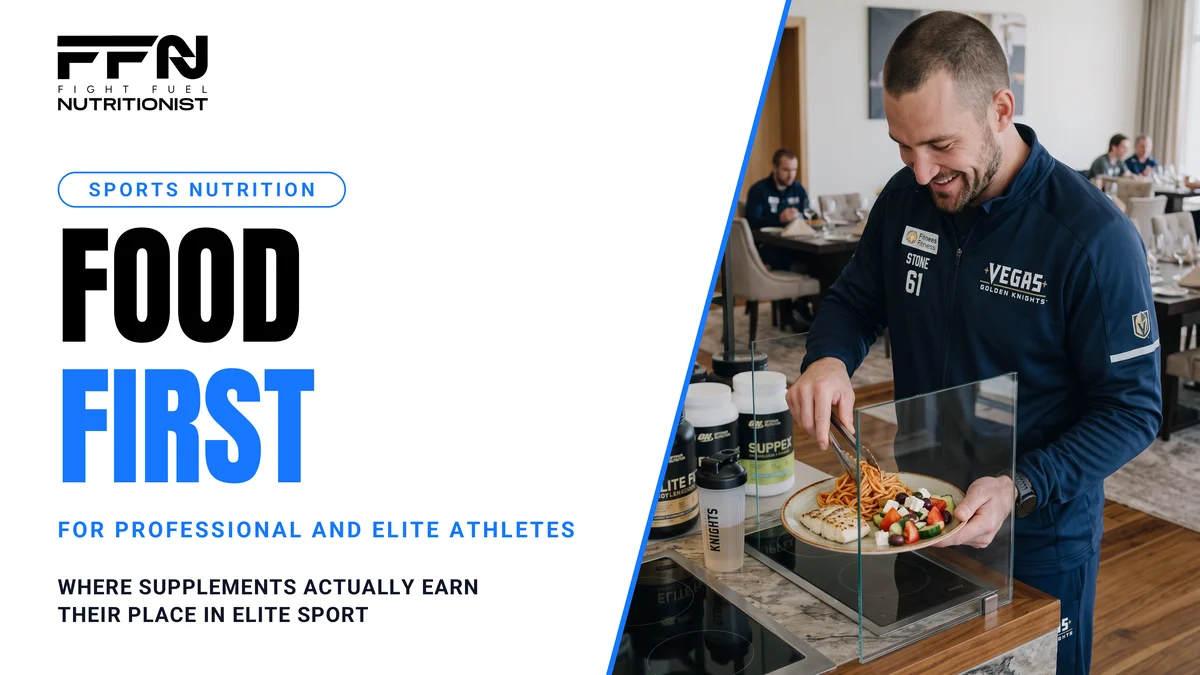
Why whole food comes first in elite sport, and when supplements actually earn their place
Walk into any professional locker room, any elite training facility, any team bus, and you will see supplements. Stacks of them. Pre-workout, intra-workout, post-workout. Multivitamins, greens powders, protein shakes, amino acids, fat burners, nootropics, adaptogens. For many professional athletes, supplements have become the center of their nutrition plan rather than an add-on.
However, this is a problem. Most athletes rely too much on supplements. Often, they pick products with weak or no evidence. As a result, they sometimes trade whole foods for pills and powders that cannot do the same job. Moreover, the supplement industry is poorly controlled. Contamination with banned substances remains a real and career-ending risk for any athlete under anti-doping control.
On the other hand, a blanket “food only” view misses something key. Specifically, a small number of supplements have strong evidence and give results that food alone cannot match. Moreover, specific settings — clinical deficiency, practical limits around competition, high training loads, tough environments — make supplement use a fair choice.
This article covers the food-first principle, why it matters, and where supplements earn their place in a professional athlete’s nutrition plan.
Table of Contents
ToggleKey Points
- Whole food should always form the base of sports nutrition for professional athletes
- The supplement industry is poorly controlled and contamination with banned substances is a real risk
- Most heavily marketed supplements have weak or no evidence behind them
- Supplements should fill real gaps, not replace proper food choices
- A small group of supplements have strong evidence and give effects that food alone cannot match — creatine and beta-alanine are the clearest examples
- Clinical deficiencies, competition-day logistics, and tough environmental demands can justify targeted use
- Third-party tested products are a must for any athlete under anti-doping control
- Supplement choices should always be personal, evidence-based, and guided by a professional
Why Food Comes First
Food gives more than nutrients alone
Whole food is not just a source of macronutrients. It gives thousands of compounds — vitamins, minerals, polyphenols, fiber, fatty acids, and active compounds — that work together in ways no single supplement can match. For example, the vitamin C in an orange does not act alone. Flavonoids, fiber, water, and other compounds travel with it and shape how the body uses it.
Moreover, food carries social, cultural, and personal value that no supplement can replace. Specifically, meals anchor routines, build habits, and help athletes stay on track across long careers. As a result, whole food gives the energy, protein, and vitamins that support every other nutrition choice a professional athlete makes.
The rules problem
Rules matter. The supplement industry is poorly controlled in most countries. Evidence has shown again and again that a meaningful share of sports supplements on the market contain items not listed on the label. For example, these include stimulants, muscle-building compounds, and other banned substances that can end a career. Therefore, every supplement an athlete takes under anti-doping control carries risk.
Most supplements do not work
Most supplements do not give real performance benefits. Specifically, out of the hundreds of products marketed to athletes, only a small group have strong, steady evidence behind them. As a result, most money spent on supplements in professional sport gives no real gain.
Key Takeaway
✔ Whole food gives nutrition, function, and practical benefits that supplements cannot match. Moreover, the regulatory risk and weak evidence for most products make food-first a safer and better start.
The Problem: Over-Reliance on Supplements
At the professional level, athletes often use supplements in ways that work against them. Several patterns come up across sports.
Using supplements to cover up a poor diet
Some athletes use supplements to cover up a poor diet. For example, they take multivitamins to offset bad food choices. They rely on protein shakes instead of eating real meals. They use energy drinks to make up for under-fueling during training. However, this does not fix the real problem. Instead, it hides the problem and gives a false sense of doing enough.
Chasing trends
Others chase trends. Specifically, heavily marketed products — collagen, mushroom blends, exotic adaptogens, branded performance formulas — often replace choices that should rest on evidence and individual need. As a result, money, focus, and anti-doping risk go toward products that add no real value.
Stacking products without knowing what is in them
Many athletes stack products. They take many supplements at once — a pre-workout, an amino blend, an energy drink, a nootropic, a fat burner. Often, they do not know what is in each product, how the products mix, or whether the total intake crosses safe or banned limits. As a result, the risk of contamination, side effects, or unintended doping violations stacks up as well.
The common thread
The common thread is simple. Supplements are treated as a fix when they should be treated as a targeted tool. The food-first view is not anti-supplement. Instead, it is about building nutrition in the right order — food as the base, supplements used only where needed.
Key Takeaway
✔ Over-reliance on supplements hides poor nutrition, wastes money on products without evidence, and raises contamination risk. Therefore, supplements should work as targeted tools, not as the base of a nutrition plan.
The Solution: Food First, But Not Always
The food-first view has two parts. First, whole food should always form the base of a professional athlete’s nutrition. Second, specific settings make supplement use a fair and sometimes key choice.
When supplements fill a practical gap
Sometimes, nutrition targets are hard to meet through food alone. For example:
- Daily protein around a hard training session, where a protein drink may work better than a full meal
- Carbohydrate during a long training session or race, where sports drinks or gels give quick energy that solid food cannot match
- Post-training recovery windows during travel, where real food options are limited
In these cases, supplements do not replace food. Instead, they solve a real-world problem that food alone cannot solve as well.
When supplements give effects food cannot match
A small number of supplements give results that food alone cannot deliver, even in large amounts. The clearest examples include:
- Creatine monohydrate — widely researched, supports strength, power, repeated sprint performance, and lean mass. The effective dose cannot come from normal meat intake alone
- Beta-alanine — supports high-intensity performance lasting 1 to 4 minutes by raising muscle carnosine. The loading dose is not possible through food
- Caffeine — a well-known aid for endurance, power, and mental performance at specific doses and timing
- Dietary nitrate — from beetroot juice or concentrate, supports endurance performance and may improve efficiency
These supplements rest on decades of research, steady results across groups, and clear mechanisms. As a result, their use in professional sport is fair when they fit the athlete and the demand.
When clinical deficiency is present
Blood work sometimes shows real deficiencies that must be fixed. For example:
- Iron deficiency, mainly in endurance athletes and female athletes
- Vitamin D shortage, mainly in athletes with limited sun or darker skin at higher latitudes
- Vitamin B12 shortage in athletes on plant-based diets
- Other vitamin or mineral gaps found through testing
In these cases, supplement use is not optional. Instead, it is a targeted step to fix a measurable issue, ideally under expert care and reviewed often.
When competition or environment demand it
Specific demands also justify targeted supplement use:
- Electrolytes during hot and humid competition
- Sodium bicarbonate or beta-alanine for specific high-intensity events
- Iron and vitamin D checks during altitude training
- Melatonin under expert guidance for travel across time zones
Key Takeaway
✔ Supplements earn their place when they fill real gaps food cannot solve, give effects food cannot match, fix clinical deficiencies, or support tough environmental demands. Outside these cases, food alone is almost always enough.
Practical Application: Building a Food-First Strategy
Turning the principle into real-world action at the professional level involves five steps.
Step 1: Build the base with food
Daily nutrition should rest on whole foods. Specifically, this means enough energy, protein spread across the day, carbohydrate matched to training load, healthy fats, and a wide range of fruits, vegetables, and whole grains. No supplement makes up for a poor base.
Step 2: Find real gaps with data
Before adding any supplement, the question should be simple. What does the evidence say this athlete really needs? In practice, this means blood work, diet review, training load review, and a clear picture of the competition demands. As a result, supplement choices should follow data, not marketing.
Step 3: Use evidence-based supplements where they add value
For a small group of well-researched products — creatine, beta-alanine, caffeine, nitrate, and specific clinical-use supplements — use is fair when the athlete, sport, and setting call for it. Therefore, plans should follow evidence-based doses, not marketing claims.
Step 4: Manage contamination risk
Any athlete under anti-doping control should only use supplements that are third-party tested for banned substances. For example, Informed Sport and NSF Certified for Sport check products against WADA-prohibited substances. Moreover, athletes should keep batch numbers and records in case of positive tests.
Step 5: Review and adjust
Supplement needs change. Specifically, training blocks, competition phases, travel, environmental settings, and blood work results all shift what the athlete needs. Therefore, plans should be checked often and adjusted based on data and demands.
| Situation | Food First | Supplement Justified |
|---|---|---|
| Daily macronutrient intake | ✓ | Rarely |
| Practical post-training window | ✓ | Sometimes |
| Specific performance need (creatine, beta-alanine) | — | ✓ Evidence-based |
| Clinical deficiency on blood work | — | ✓ Until fixed |
| Environmental demand (electrolytes, altitude) | Partial | ✓ Targeted |
| General health, immune, recovery claims | ✓ | Rarely justified |
Key Takeaway
✔ A food-first plan is simple. It starts with a strong nutrition base, finds real gaps through data, uses evidence-based supplements where they add value, manages contamination risk, and adjusts as demands change.
Conclusion
The food-first view is one of the most important ideas in sports nutrition. At the professional level, it does not mean avoiding supplements altogether. Instead, it means building nutrition in the right order — whole food as the base, targeted supplements used only where they earn their place.
Moreover, most supplements sold to professional athletes do not give measurable performance benefits. Specifically, many carry contamination risks that can end a career. However, a small number of evidence-based supplements do support performance, and specific clinical or environmental settings justify their use.
The athletes who perform at the top for the longest careers are not the ones with the biggest supplement stacks. Instead, they are the ones whose nutrition rests on a strong base of real food, with supplements used only where the evidence and the setting call for them.
This article sets the principle. Furthermore, future articles in this series will cover specific supplements with strong evidence, plans for their use, contamination risk, and sport-specific supplement plans.
At the elite level, food comes first. But not always alone.
Key Takeaway
✔ Food first means building nutrition on a base of whole food and using supplements only where they fill real gaps or give effects food cannot match. Therefore, every supplement choice should be evidence-based, individual, and handled with care around contamination risk.
References
- Close GL, Kasper AM, Walsh NP, et al. (2019). “Food first but not always food only”: Recommendations for using dietary supplements in sport. International Journal of Sport Nutrition and Exercise Metabolism, 29(2), 146–165.
- Maughan RJ, Burke LM, Dvorak J, et al. (2018). IOC consensus statement: dietary supplements and the high-performance athlete. British Journal of Sports Medicine, 52(7), 439–455.
- Thomas DT, Erdman KA, Burke LM. (2016). Position of the Academy of Nutrition and Dietetics, Dietitians of Canada, and the American College of Sports Medicine: Nutrition and athletic performance. Journal of the Academy of Nutrition and Dietetics, 116(3), 501–528.
- Peeling P, Binnie MJ, Goods PSR, Sim M, Burke LM. (2018). Evidence-based supplements for the enhancement of athletic performance. International Journal of Sport Nutrition and Exercise Metabolism, 28(2), 178–187.
- Kreider RB, Kalman DS, Antonio J, et al. (2017). International Society of Sports Nutrition position stand: safety and efficacy of creatine supplementation in exercise, sport, and medicine. Journal of the International Society of Sports Nutrition, 14, 18.
- Trexler ET, Smith-Ryan AE, Stout JR, et al. (2015). International Society of Sports Nutrition position stand: beta-alanine. Journal of the International Society of Sports Nutrition, 12, 30.
- Guest NS, VanDusseldorp TA, Nelson MT, et al. (2021). International Society of Sports Nutrition position stand: caffeine and exercise performance. Journal of the International Society of Sports Nutrition, 18(1), 1.
- Jones AM. (2014). Dietary nitrate supplementation and exercise performance. Sports Medicine, 44(Suppl 1), S35–S45.
- Martínez-Sanz JM, Sospedra I, Ortiz CM, Baladía E, Gil-Izquierdo A, Ortiz-Moncada R. (2017). Intended or unintended doping? A review of the presence of doping substances in dietary supplements used in sports. Nutrients, 9(10), 1093.
- Larson-Meyer DE, Woolf K, Burke L. (2018). Assessment of nutrient status in athletes and the need for supplementation. International Journal of Sport Nutrition and Exercise Metabolism, 28(2), 139–158.
- Garthe I, Maughan RJ. (2018). Athletes and supplements: prevalence and perspectives. International Journal of Sport Nutrition and Exercise Metabolism, 28(2), 126–128.


