
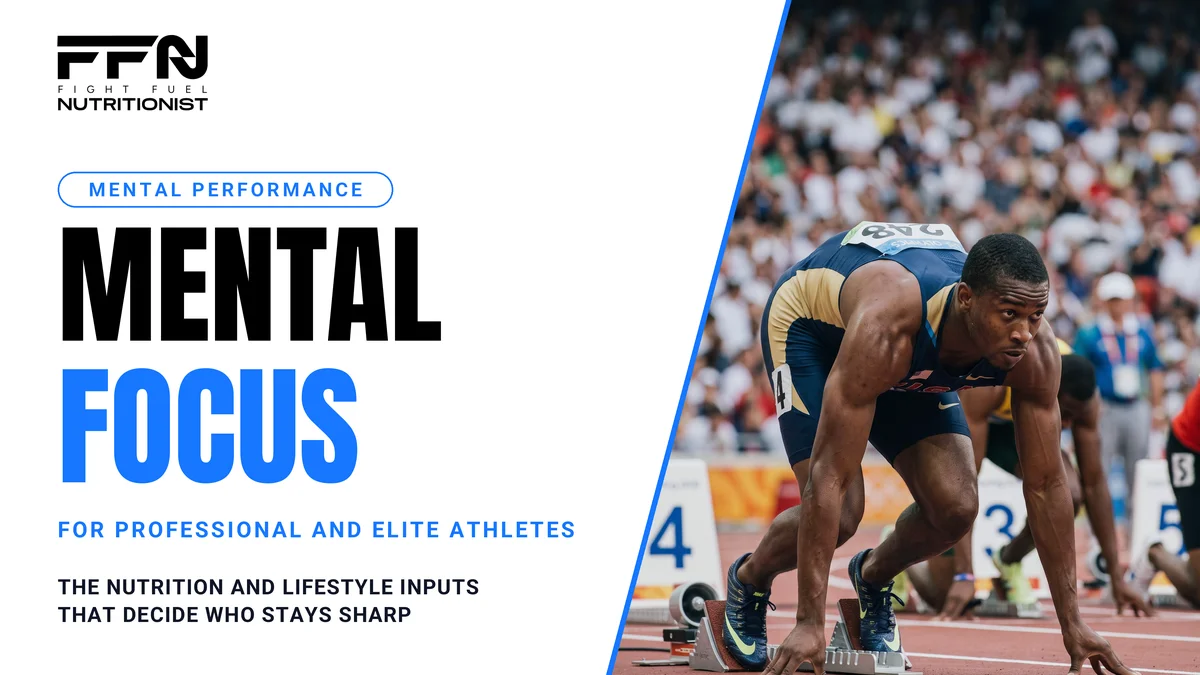
How nutrition, lifestyle, and mental performance strategies shape focus, decision-making, and consistency under pressure
Mental focus is one of the most underrated variables in professional sport. Physical ability gets the headlines. However, at the elite level, the difference between winning and losing is often not who is faster, stronger, or more skilled. Instead, it is who stays sharp longer, makes better decisions under pressure, and holds focus when it matters most.
Focus is trainable. Moreover, it is highly sensitive to nutrition, hydration, sleep, sunlight, caffeine, and specific mental performance practices. As a result, the athletes who protect their focus as deliberately as they train their bodies tend to perform more consistently, recover faster from mistakes, and close out the moments that define a career.
This article covers mental focus from a sports nutrition point of view first, because nutrition is the foundation of mental performance. However, nutrition does not work alone. Therefore, it also covers the lifestyle inputs that sharpen focus — sleep and sunlight — along with extra strategies such as breathwork, self-talk, and visualization that elite athletes use to hold focus under pressure.
Key Points
- Mental focus directly shapes decision-making, execution under pressure, and consistency across long competitions
- Daily eating patterns shape the state in which focus is possible
- Stable blood sugar is one of the most powerful drivers of sustained mental performance
- Pre-competition and in-competition fueling directly support focus in the later stages of competition
- Hydration status affects focus, reaction time, and decision-making at deficits as small as 1 to 2% of body mass
- Food-first principles apply — most focus-supporting benefits come from a well-built diet, with targeted supplements where they add value
- Caffeine and omega-3s are the supplements with the strongest evidence for mental performance
- Sleep is the single largest lifestyle factor affecting next-day focus and decision-making
- Sunlight exposure anchors the body clock, supports vitamin D status, and directly improves daytime alertness
- Breathwork, self-talk, and visualization are evidence-based practices that work alongside nutrition
- Protecting focus is a daily process, not a competition-day tactic
Why Mental Focus Decides Elite Performance
The mental demands of professional sport
Every professional sport demands focus under pressure. For example, a striker reading a defender, a tennis player assessing a second serve, a Formula 1 driver managing tire temperature at 300 km/h, a golfer selecting the right club on the 72nd hole — all of these depend on the ability to process information, make decisions, and execute precisely in real time. Moreover, these demands do not arrive at convenient moments. Instead, they arrive after hours of competition, at the end of long tournament weeks, and often across many time zones.
When focus slips, performance slips first
Across sports, mental performance often declines before physical performance. In other words, decisions slip before legs slip. Therefore, a player who can hold focus for the full 90 minutes, the full final set, or the full back nine has a meaningful edge over one whose focus fades as fatigue builds.
Focus is trainable
However, focus is not fixed. It is the product of physical state, nutritional status, sleep, hydration, sunlight exposure, and trained mental performance skills. As a result, athletes who understand how to support their focus have more of it, more often, for longer.
Key Takeaway
✔ Mental focus is a trainable performance variable that drives decision-making, execution, and consistency at the elite level. Therefore, protecting it is a direct performance investment.
The Nutrition Inputs That Shape Focus
Nutrition is the foundation of mental performance. Every brain signal, every decision, every moment of attention depends on the energy and nutrients available to the brain. Therefore, nutrition strategies for focus start with daily food choices and extend through competition-day fueling, with supplements playing a targeted supporting role.
Daily eating patterns
First, focus is built on what an athlete eats every day, not just on what they eat before competition. A daily diet that supports stable energy, adequate protein, healthy fats, and a wide range of vitamins and minerals creates the state in which focus is possible.
Key elements of a focus-supporting daily diet:
- Adequate energy intake matched to training load. Chronic under-fueling impairs mental performance, mood, and decision-making, not just physical output
- Protein spread across the day at roughly 0.3 to 0.4 g per kg of body weight per meal. Protein supplies amino acids such as tyrosine and tryptophan, the building blocks of brain signaling chemicals
- Quality carbohydrates from whole grains, fruits, and vegetables, which support stable blood sugar and deliver fiber, vitamins, and polyphenols
- Healthy fats from sources such as oily fish, extra virgin olive oil, nuts, and seeds. Omega-3 fatty acids from fish support brain structure and function, while excess saturated fat and ultra-processed food worsen mood and mental performance over time
- Wide range of fruits and vegetables providing polyphenols, antioxidants, and nutrients that support brain health and reduce inflammation
Consistency matters more than perfection. Athletes who eat well most of the time build a stronger foundation than those who chase perfect meals around competition but under-fuel the rest of the week.
Blood sugar stability
The brain runs mainly on glucose. Moreover, it is sensitive to glucose swings in both directions. High peaks followed by sharp crashes impair focus, decision-making, and mood. In contrast, stable blood sugar supports sustained mental performance across long competitions.
How to keep blood sugar stable
In practice, this means:
- Meals that combine complex carbohydrates, protein, and healthy fats produce more stable blood sugar than high-glycemic meals eaten alone
- Ultra-processed snacks and sugar-heavy breakfasts create swings that undermine focus within hours
- On-course or in-game fueling should avoid large single doses of fast sugars unless timed for an endurance demand
- Post-training and post-competition nutrition should refill glycogen (your body’s stored carbohydrate) without creating sharp post-meal sugar swings that impair evening focus and sleep
Pre-competition fueling
Second, the pre-competition meal shapes focus across the full competition window. A meal eaten 2 to 4 hours before competition should deliver enough carbohydrate to top up glycogen, enough protein to stabilize blood sugar, and a manageable amount of fat and fiber to avoid gut problems. The exact composition depends on the sport, the competition time, and the athlete’s individual tolerance.
Pre-competition principles
In practice:
- Familiar foods only — competition day is not the time to experiment
- Adequate fluid intake without over-drinking in the final hour
- Caffeine, if used, timed to peak at competition start
In-competition fueling
Third, during long competitions, in-event fueling directly supports focus in the later stages. Carbohydrate intake during prolonged efforts maintains blood sugar, supports working muscles, and — particularly relevant to focus — supports the brain. Even carbohydrate mouth-rinsing (without swallowing) can improve mental performance during endurance events, pointing to a direct brain-level effect.
For sports with shorter competition windows, in-event fueling may not be needed. However, for sports lasting more than 60 to 90 minutes of continuous effort, targeted carbohydrate intake is one of the most evidence-based ways to protect focus in the final minutes.
Post-competition nutrition
Fourth, post-competition nutrition affects not just physical recovery but also next-day focus. Refilling glycogen, replacing fluid and electrolytes, and supporting muscle repair and rebuilding all shape how sharp an athlete feels the next morning. Moreover, nutrition choices in the evening after competition shape sleep quality — and sleep quality is one of the largest drivers of next-day mental performance.
Post-competition principles
In practice:
- Combine carbohydrate and protein in the first hour after competition
- Include fluid with sodium to restore hydration
- Avoid heavy alcohol intake, which impairs sleep and therefore impairs recovery and next-day focus
- Finish large meals at least 2 to 3 hours before intended sleep to avoid harming sleep quality
Hydration
Hydration directly affects mental performance. Even mild dehydration — fluid deficits of 1 to 2% of body mass — can reduce reaction time, impair decision-making, and worsen mood. Moreover, these effects show up before thirst does, meaning athletes can lose focus without recognizing the underlying cause.
In addition, hydration interacts with other focus inputs. For example, a dehydrated athlete with a caffeine intake plan will not get the expected benefit, and a dehydrated athlete in hot conditions will lose focus faster than a well-hydrated one. Therefore, hydration is not separate from focus — it is one of its main drivers.
Targeted supplements where food cannot deliver
Food comes first, but not always alone. A small number of supplements have strong evidence for mental performance and earn their place when used deliberately.
Caffeine
Caffeine is one of the most studied performance aids in sport. In addition to its well-documented effects on endurance and power, caffeine improves attention, reaction time, alertness, and perceived effort.
Key practical points:
- Effective doses for mental performance range from 3 to 6 mg per kg of body weight
- Timing matters — caffeine peaks in the blood around 45 to 60 minutes after intake
- Late-day caffeine can impair sleep and therefore impair next-day focus
- Individual response varies — some athletes break down caffeine slowly and need lower doses or earlier timing
Omega-3 fatty acids
Omega-3 fatty acids — EPA and DHA, the active components of fish oil — play structural and working roles in the brain. Evidence suggests likely benefits for mental performance, mood, and recovery from training-induced stress. Athletes with low omega-3 intake from food (fatty fish) may benefit from dietary changes or, in some cases, supplements under professional guidance.
Other nutrients
Other nutrients also play a role in mental performance. For example, iron deficiency impairs focus and should be addressed clinically. Vitamin B12 deficiency affects mental performance in plant-based athletes. Tyrosine and creatine have some evidence for mental performance under stress and sleep deprivation, though the evidence base is less developed than for caffeine and omega-3s.
Key Takeaway
✔ Daily eating patterns, blood sugar stability, pre- and in-competition fueling, hydration, and targeted supplements are the nutrition inputs with the clearest evidence for supporting focus. Therefore, these factors should be managed deliberately, not left to chance.
The Lifestyle Inputs That Shape Focus
Beyond nutrition, two lifestyle factors have the largest measurable impact on mental performance — sleep and sunlight. Moreover, both are closely linked through the body clock, and both are often under-managed at the professional level.
Sleep
Sleep is the single most important lifestyle input for focus. Too little sleep impairs focus more than any other single factor. Moreover, the effects show up the next day in reaction time, decision-making accuracy, and the ability to hold attention under pressure.
At the professional level, sleep should be managed as deliberately as training. Consistent sleep timing, morning light exposure, evening light restriction, and caffeine cutoffs in the afternoon are the highest-leverage practices available.
Sunlight and body clock anchoring
Sunlight exposure is one of the most underused focus inputs in professional sport. Bright natural light acts on the brain’s master clock and directly shapes alertness, mood, and the timing of sleep.
Why morning sunlight matters
Morning sunlight anchors your body clock, supports the natural morning rise in cortisol (your main stress hormone) that sharpens morning mental performance, and indirectly improves sleep onset later that night. Moreover, bright light exposure during the day improves alertness and reduces afternoon energy dips. Evidence shows measurable improvements in reaction time, sustained attention, and mood with consistent daytime bright light exposure.
Vitamin D
Sunlight also drives vitamin D synthesis. Vitamin D plays a role in mental performance, mood, and brain protection. Moreover, vitamin D deficiency is common in athletes training indoors, living at higher latitudes, or with darker skin — and deficiency is linked to reduced focus, lower mood, and higher rates of depression. Therefore, professional athletes should have vitamin D status checked through blood work and supplement when levels fall below clinical targets.
Evening light restriction
Finally, bright light exposure in the evening disrupts the body clock and melatonin release. Screens, overhead lighting, and artificial bright light in the hours before bed delay sleep onset, reduce sleep quality, and impair next-day focus. Therefore, evening light restriction is as important as morning light exposure.
Practical principles for sunlight and body clock support
In practice:
- 10 to 20 minutes of outdoor natural light within the first hour of waking
- Bright daytime light exposure, ideally outdoors, to anchor alertness and mood
- Check vitamin D status through blood work and supplement under professional guidance if deficient
- Reduce bright light, especially screens, in the 1 to 2 hours before intended sleep
Key Takeaway
✔ Sleep and sunlight are the two largest lifestyle factors for focus. Moreover, both are linked through the body clock, and both must be managed deliberately at the professional level to support next-day mental performance.
Extra Strategies: Beyond Nutrition and Lifestyle
Nutrition and lifestyle form the foundation. However, elite athletes layer added practices on top to sharpen focus in real time and under pressure. The following three strategies have strong research support and are widely used in professional sport.
Breathwork
Breathwork is the deliberate control of breathing rate and depth to shape physical and mental state. Slow, controlled breathing — typically nasal, with extended exhales — activates the calming side of your nervous system, reduces heart rate, and lowers perceived stress. Moreover, this shift supports clearer decision-making, reduces anxiety in high-pressure moments, and improves recovery between efforts.
How athletes use breathwork
Practical uses in professional sport include:
- Pre-competition breathing routines to reduce pre-match or pre-round anxiety
- In-competition resets after mistakes, lost points, or between plays
- Post-competition wind-down to support recovery and sleep
Basic protocols include box breathing (4 seconds inhale, 4 hold, 4 exhale, 4 hold) and extended exhale breathing (inhale 4 seconds, exhale 6 to 8 seconds). These are simple, effective, and can be practiced anywhere.
Self-talk
Self-talk refers to the internal dialogue an athlete uses during training and competition. Evidence in sport psychology consistently shows that structured self-talk improves performance, reduces anxiety, and supports focus under pressure. Two types of self-talk have the strongest evidence:
- Instructional self-talk — short, specific cues that direct attention to a technical or tactical element (“stay low,” “watch the release,” “breathe before serve”)
- Motivational self-talk — brief, energizing phrases that maintain effort and confidence during difficult moments (“one more,” “I belong here,” “let’s go”)
Moreover, effective self-talk is trained, not improvised. Therefore, elite athletes develop their own self-talk cues, practice them in training, and use them consistently in competition.
Visualization
Visualization, or mental imagery, involves rehearsing performance in the mind before it happens. Evidence shows that visualization activates many of the same brain regions as physical practice. As a result, regular visualization improves skill execution, builds confidence, reduces performance anxiety, and sharpens focus under pressure.
What effective visualization looks like
Effective visualization is:
- Specific — the athlete pictures a concrete scenario (the serve, the shot, the penalty) rather than a vague outcome
- Multisensory — it includes sight, sound, feel, and even smell to match the real environment
- Process-focused — the athlete rehearses execution, not just results
- Practiced — like self-talk, it improves with consistent use
Moreover, visualization is used in almost every elite sport — from Olympic weightlifters rehearsing lifts to F1 drivers walking circuits mentally to golfers seeing the shot before striking the ball.
Key Takeaway
✔ Breathwork, self-talk, and visualization are evidence-based mental performance tools that work alongside nutrition and lifestyle. Therefore, using them creates a more complete approach to focus at the elite level.
Practical Application: Building Focus Into Your Routine
Turning the principles into real-world practice involves layering habits across training, competition, and recovery.
Daily habits
First, focus is built every day, not just on competition day:
- Stable blood sugar through balanced meals across the day
- Consistent hydration — not catch-up drinking before competition
- Adequate omega-3 intake through food or targeted supplements
- Consistent sleep timing and morning sunlight exposure
- Daytime bright light exposure, ideally outdoors
- Evening light restriction to support sleep quality
- Short daily breathwork or mindfulness practice
Pre-competition routine
Second, the hours before competition are where nutrition and mental performance strategies come together:
- A pre-competition meal that supports stable blood sugar
- Hydration status checked and adjusted
- Caffeine timed to peak at the start of competition if used
- Visualization of the performance
- Breathwork to manage arousal level
In-competition tools
Third, during competition, smaller actions can reset focus when it drifts:
- Structured self-talk cues between points, plays, or shots
- Brief breathwork resets after mistakes
- Consistent on-course or in-game fueling to keep blood sugar stable
Post-competition recovery
Finally, post-competition practices support recovery and prepare for the next day:
- Recovery nutrition to refill glycogen and support repair
- Hydration replacement with sodium where relevant
- Wind-down breathing to support sleep onset
- A brief review to anchor learning, without dwelling
| Focus Input | When It Matters Most |
|---|---|
| Daily eating patterns | Every day, as the foundation |
| Blood sugar stability | Throughout competition, especially late stages |
| Pre-competition fueling | 2 to 4 hours before competition |
| In-competition fueling | Events longer than 60 to 90 minutes |
| Hydration | Entire day, especially in heat and long events |
| Caffeine | Timed 45 to 60 minutes before competition start |
| Omega-3s | Daily, as a chronic dietary input |
| Sleep | Every night, especially night before competition |
| Morning sunlight | Within first hour of waking, daily |
| Evening light restriction | 1 to 2 hours before intended sleep |
| Breathwork | Pre-competition, between efforts, post-competition |
| Self-talk | Between plays, during pressure moments |
| Visualization | Daily practice, pre-competition peaking |
Key Takeaway
✔ Mental focus at the elite level is built through daily habits, competition-day routines, and in-competition tools. Therefore, the athletes who layer these consistently have more focus, more often, when it matters.
Conclusion
Mental focus is one of the most underrated performance variables in professional sport. It decides outcomes in moments that physical ability alone cannot control. Moreover, it is highly sensitive to the choices athletes make about their nutrition, hydration, caffeine, sleep, sunlight, and mental performance practices.
Nutrition is the foundation. Stable blood sugar, adequate hydration, well-timed pre- and in-competition fueling, and consistent daily eating patterns create the state in which focus is possible. On top of that foundation, sleep and sunlight anchor the body clock that drives alertness and mood, and evidence-based practices like breathwork, self-talk, and visualization sharpen focus in real time under pressure.
At the elite level, focus is not a personality trait. Instead, it is a trainable capacity built through deliberate habits. Therefore, the athletes who protect their focus as seriously as they train their bodies are the ones who close out moments and extend careers.
This article sets the foundation. Moreover, future articles in this series will go deeper into each of the core parts — caffeine protocols, omega-3 supplements, vitamin D for athletes, breathwork for performance, self-talk under pressure, and visualization for skill execution.
Key Takeaway
✔ Mental focus is built on a foundation of nutrition, lifestyle, and evidence-based mental performance practices. Therefore, managing it deliberately is one of the highest-return investments a professional athlete can make.
References
- Meeusen R, Decroix L. (2018). Nutritional supplements and the brain. International Journal of Sport Nutrition and Exercise Metabolism, 28(2), 200–211.
- Meeusen R. (2014). Exercise, nutrition and the brain. Sports Medicine, 44(Suppl 1), S47–S56.
- Guest NS, VanDusseldorp TA, Nelson MT, et al. (2021). International Society of Sports Nutrition position stand: caffeine and exercise performance. Journal of the International Society of Sports Nutrition, 18(1), 1.
- Adan A, Serra-Grabulosa JM. (2010). Effects of caffeine and glucose, alone and combined, on cognitive performance. Human Psychopharmacology, 25(4), 310–317.
- Jäger R, Kerksick CM, Campbell BI, et al. (2017). International Society of Sports Nutrition position stand: protein and exercise. Journal of the International Society of Sports Nutrition, 14, 20.
- Mickleborough TD. (2013). Omega-3 polyunsaturated fatty acids in physical performance optimization. International Journal of Sport Nutrition and Exercise Metabolism, 23(1), 83–96.
- Wittbrodt MT, Millard-Stafford M. (2018). Dehydration impairs cognitive performance: a meta-analysis. Medicine and Science in Sports and Exercise, 50(11), 2360–2368.
- Jeukendrup AE, Rollo I, Carter JM. (2013). Carbohydrate mouth rinse: performance effects and mechanisms. Sports Science Exchange, 26(118), 1–8.
- Close GL, Leckey J, Patterson M, et al. (2013). The effects of vitamin D(3) supplementation on serum total 25[OH]D concentration and physical performance: a randomised dose-response study. British Journal of Sports Medicine, 47(11), 692–696.
- Blume C, Garbazza C, Spitschan M. (2019). Effects of light on human circadian rhythms, sleep and mood. Somnologie, 23(3), 147–156.
- Hardy J. (2006). Speaking clearly: a critical review of the self-talk literature. Psychology of Sport and Exercise, 7(1), 81–97.
- Cumming J, Williams SE. (2012). The role of imagery in performance. In Murphy S (Ed.), The Oxford Handbook of Sport and Performance Psychology, Oxford University Press.
- Laborde S, Allen MS, Borges U, et al. (2022). Effects of voluntary slow breathing on heart rate and heart rate variability: a systematic review and meta-analysis. Neuroscience and Biobehavioral Reviews, 138, 104711.
- Halson SL. (2014). Sleep in elite athletes and nutritional interventions to enhance sleep. Sports Medicine, 44(Suppl 1), 13–23.


