
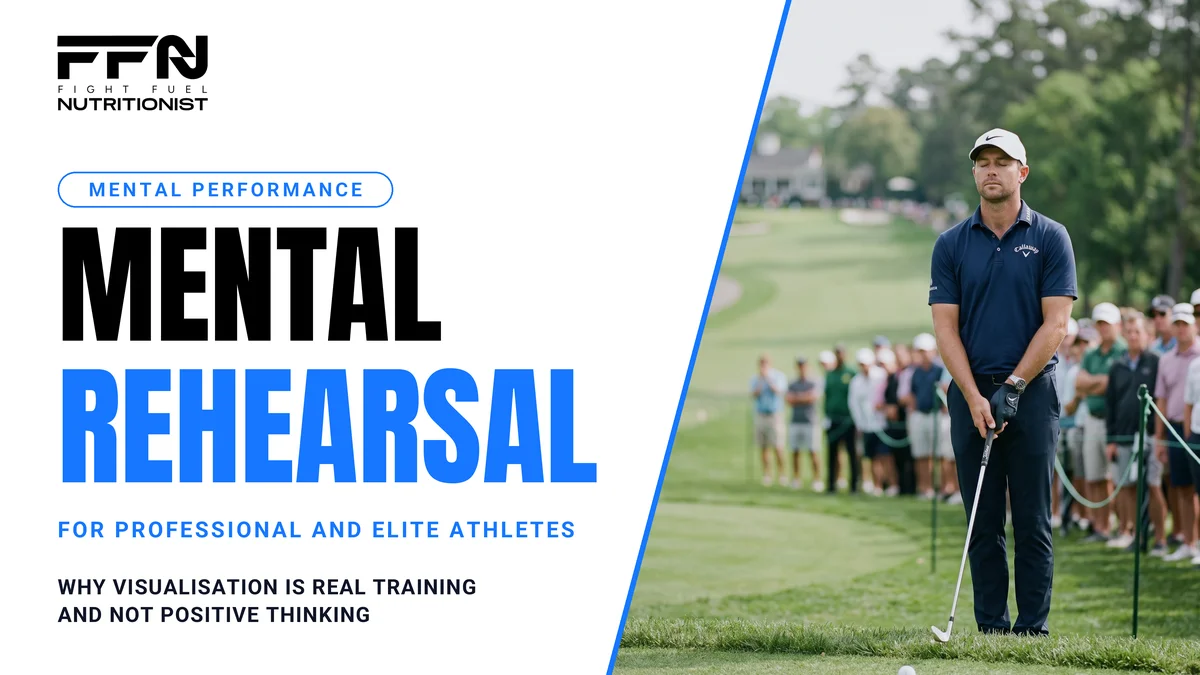
Mental Rehearsal Improves Skill Execution, Confidence, and Decision-Making in Competition
Mental rehearsal is one of the oldest tools in elite sport. Long before sports psychology became a formal discipline, athletes were closing their eyes before competition and running through their performance in their heads. What has changed is the science. Decades of evidence now show that structured visualization is not just psychological positive thinking — it produces measurable changes in your brain and your performance.
For professional and elite athletes, the gap between athletes who use visualization deliberately and athletes who treat it as an afterthought is meaningful. The techniques that work are not vague “see yourself winning” exercises. Instead, they are specific, structured protocols that train the same brain regions your body uses during real performance.
This article covers what visualization actually is, what the evidence shows, and how to use it as a professional or elite athlete to sharpen skills, prepare for high-pressure moments, and improve decision-making under fatigue.
Key Points
- Visualization is a structured mental rehearsal technique that activates many of the same brain regions used during real movement and decision-making
- Strong evidence supports visualization for skill acquisition, motor learning, confidence, and pre-competition preparation
- The most effective visualization is multi-sensory — including sight, sound, feel, and emotion — and uses a first-person perspective rather than watching yourself from outside
- Visualization works best as a complement to physical training, not a substitute — combining mental and physical practice produces better results than either alone
- Different types of visualization serve different goals — skill rehearsal, performance preparation, problem-solving under pressure, and recovery from injury
- Athletes recovering from injury can use visualization to maintain skill, reduce strength loss, and accelerate return to play
- The gap between athletes who use visualization well and those who don’t is meaningful — but it requires consistent practice, not occasional use
- A complete visualization program integrates short daily practice with targeted use before training, before competition, and during recovery from setbacks
What Visualization Actually Is
The science behind mental rehearsal
When you visualize a movement in detail, your brain activates many of the same brain regions used during real movement. This is one of the most important findings in sports psychology and neuroscience. The regions involved in planning and executing movement are all engaged during vivid mental rehearsal — including the parts of your brain that fire when you actually move.
In practical terms, this means visualization is not just “thinking about it.” It is partial brain training. You are activating the same circuits you would use in physical practice, just at a lower intensity and without the physical execution.
Why it works for athletes
The overlap between imagined and actual movement explains why visualization produces real performance benefits:
- Repeated mental rehearsal strengthens the movement patterns underlying skill execution
- Pre-competition visualization reduces anxiety and improves readiness
- Visualization during injury recovery slows the loss of skill and strength
- Mental rehearsal of pressure scenarios improves decision-making when those situations actually occur
In other words, visualization gives you additional repetitions of skill, decision-making, and emotional preparation — without the physical cost of actual training.
What good visualization actually looks like
Effective visualization is not vague mental imagery. It has specific characteristics:
- First-person perspective. You see the action through your own eyes, not as if watching yourself on video
- Multi-sensory. You include what you see, hear, feel in your body, and the emotions of the moment
- Real-time pacing. The mental rehearsal happens at the same speed as actual performance, not sped up
- Specific and detailed. Specific opponents, conditions, locations, and outcomes — not generic
- Includes the controllables. What you do, how you respond, your technique and decisions — not just the result
The athletes who get the most from visualization are not the ones with the most vivid imaginations. Instead, they are the ones who practice these specific elements consistently.
Key Takeaway
✔ Visualization activates many of the same brain regions used during real movement, making it a form of partial brain training. The most effective visualization is first-person, multi-sensory, real-time, and detailed — not vague positive imagery.
What the Evidence Shows
Skill acquisition and motor learning
The strongest evidence base for visualization is in skill learning and movement performance. Mental practice consistently improves performance across a wide range of skills — including technical execution, accuracy, and movement timing — across virtually every sport that has been tested.
The effects are largest when visualization is combined with physical practice rather than used in place of it. In other words, mental practice plus physical practice consistently outperforms physical practice alone.
Confidence and anxiety regulation
Visualization also has strong evidence for psychological benefits:
- Reduced pre-competition anxiety
- Improved confidence and belief in your ability to perform
- Better emotional regulation under pressure
- Improved focus during high-arousal moments
For professional athletes, these effects matter as much as the skill benefits. The difference between performing at your level and performing below it under pressure is often a matter of state regulation rather than technical capacity.
Performance under fatigue
Emerging evidence also supports visualization for performance under fatigue. Athletes who mentally rehearse performance under tired or pressured conditions show better real-world performance in those same conditions. This applies to endurance events, late-game decision-making in team sports, and sustained performance across long competitions.
Injury recovery
One of the most underused applications is in injury recovery. Structured visualization during a layoff can reduce loss of skill and accelerate return to play. Athletes who continue mental practice during injury maintain movement patterns more effectively than those who do not.
In some cases, visualization can even slow strength loss during periods of physical inactivity. Although physical training will always be more effective, visualization gives injured athletes a way to keep training mentally when their body cannot.
Key Takeaway
✔ The evidence supports visualization for skill acquisition, confidence, anxiety regulation, performance under fatigue, and injury recovery. The benefits are largest when visualization complements physical training rather than replaces it.
Types of Visualization and When to Use Them
Skill rehearsal
The most common form of visualization involves rehearsing specific technical or tactical skills. You mentally execute the movement, decision, or sequence you want to perform, paying attention to technique, timing, and feel.
In practice, this works for:
- Technical skills (golf swing, tennis serve, free throw, penalty kick)
- Tactical sequences (set plays, race strategies, fight tactics)
- Movement patterns under different conditions (different opponents, surfaces, conditions)
How to use it: 5 to 10 minutes daily, focused on a specific skill or sequence. The mental rehearsal should match the speed and detail of actual execution.
Pre-competition preparation
Pre-competition visualization is broader than skill rehearsal. It includes the venue, opponents, conditions, your warm-up, and the early phases of competition. It serves to mentally rehearse the environment so that nothing during competition feels unexpected.
How to use it: 10 to 20 minutes the night before competition or in the hours before, depending on what works for you. Include both the smooth flow of competition and how you would respond to setbacks (a poor start, a mistake, an opponent’s strong performance).
Problem-solving and pressure scenarios
A more advanced application is visualizing high-pressure scenarios specifically. You imagine yourself in difficult situations — facing a strong opponent at a critical moment, performing while tired, recovering from a bad mistake — and rehearse how you respond.
This works because it builds emotional and mental familiarity with pressure. When the real situation arrives, your nervous system has already practiced handling it.
How to use it: regularly throughout the season, with specific focus on the kinds of pressure you actually face in competition.
Recovery and injury rehabilitation
For injured athletes, visualization serves as a way to keep training mentally during physical layoffs. Mentally rehearsing skills, sequences, and competitions during the rehabilitation period reduces the loss of skill and supports return to play.
How to use it: structured daily practice during injury, focused on the specific skills and decisions of your sport. This is often best done with the support of a sports psychologist or coach.
Key Takeaway
✔ Different types of visualization serve different goals — skill rehearsal, pre-competition preparation, pressure scenarios, and injury recovery. Each one uses the same underlying mechanisms but applies them to different aspects of performance.
Practical Application: Building a Visualization Program
How much visualization, and how often
The athletes who get the most from visualization are not the ones who do it for hours occasionally. Instead, they are the ones who practice consistently in shorter daily blocks. 5 to 15 minutes per day produces meaningful effects when done regularly.
Longer sessions (20 to 30 minutes) work well in specific contexts — pre-competition preparation, recovery from setbacks, deep skill work — but daily short practice is the foundation.
A weekly framework
For a professional athlete who wants to integrate visualization systematically:
Daily: 5 to 10 minutes of skill or sequence rehearsal, ideally at a consistent time (morning or evening works well for most athletes)
Pre-training: 2 to 5 minutes mentally rehearsing the key skills or sequences you will work on in the session
Pre-competition: 10 to 20 minutes the night before or in the hours before, covering the venue, opponents, your performance, and how you respond to setbacks
Post-competition: Brief reflection and re-visualization of moments you want to consolidate (good performances) or learn from (mistakes)
During injury or layoff: Structured daily practice (15 to 30 minutes) focused on maintaining skill and movement patterns
How to actually do it
For athletes new to structured visualization, the practical approach is:
- Find a quiet space where you will not be interrupted
- Sit or lie comfortably with your eyes closed
- Take a few slow breaths to settle into a focused state
- Choose a specific scenario — a skill, sequence, or competition moment
- Run through it in real time from a first-person perspective
- Include all senses — sight, sound, feel, emotion
- End with the outcome you want — successful execution, controlled response, calm focus
Athletes who work with a sports psychologist or mental performance coach typically progress faster than those who try to figure it out alone. This is one of the areas where professional support produces the best return.
| Application | Duration | Frequency |
|---|---|---|
| Daily skill rehearsal | 5–10 min | Daily |
| Pre-training rehearsal | 2–5 min | Before sessions |
| Pre-competition preparation | 10–20 min | Night before / day of |
| Pressure scenario practice | 10–15 min | Weekly |
| Injury recovery practice | 15–30 min | Daily during layoff |
Key Takeaway
✔ A complete visualization program is built on short daily practice, with longer targeted use before competition, during pressure scenario training, and through injury recovery. Consistency matters far more than session length, and professional support accelerates progress for most athletes.
Common Mistakes Athletes Make
Doing it occasionally instead of consistently
The biggest mistake is treating visualization as something you do before a big competition, not as a daily practice. The brain and psychological benefits come from repeated practice — not from occasional sessions before high-stakes moments.
Being too vague
Generic “see yourself winning” imagery does not produce the same benefits as specific, detailed mental rehearsal. The more specific the visualization — opponent, venue, conditions, technique, decisions — the more effective it tends to be.
Watching yourself from outside
Some athletes default to watching themselves on a mental video. However, the evidence suggests that first-person visualization (seeing through your own eyes) produces stronger brain activation than third-person visualization. First-person should be the default.
Only visualizing perfect outcomes
Always rehearsing perfect performance leaves you unprepared for setbacks. Including how you respond to mistakes, poor starts, and unexpected challenges builds the resilience to handle them in real competition.
Trying to do it without support
Most athletes who try to learn visualization on their own give up before it becomes effective. Working with a sports psychologist or mental performance coach significantly increases the likelihood of building a consistent, productive practice.
Key Takeaway
✔ The most common mistakes are doing it occasionally, being too vague, watching from outside, only rehearsing perfect outcomes, and trying to learn it without professional support. Each one is correctable with deliberate attention.
Conclusion
Visualization is real training, not positive thinking
Visualization is not a soft skill. It is a structured form of training that activates many of the same brain regions used during real performance. The evidence supports its use for skill development, confidence, anxiety regulation, decision-making under pressure, and injury recovery.
What separates athletes who use it well
For professional and elite athletes, the difference between athletes who use visualization deliberately and those who don’t is measurable. The athletes who get the most from it are not the ones who try every technique once. Instead, they are the ones who practice consistently — short daily blocks, targeted pre-competition use, and structured support during difficult periods.
The cost of doing it well is small
Visualization costs nothing. It requires no equipment beyond a quiet space and consistent attention. For athletes who treat performance seriously, building structured visualization into the training week is one of the highest-return practices available.
Key Takeaway
✔ Visualization is a structured brain training tool, not positive thinking. For professional and elite athletes who practice it consistently, it produces measurable improvements in skill, confidence, pressure management, and recovery — at minimal cost and time investment.
References
- Driskell JE, Copper C, Moran A. (1994). Does mental practice enhance performance? Journal of Applied Psychology, 79(4), 481–492.
- Holmes PS, Collins DJ. (2001). The PETTLEP approach to motor imagery: A functional equivalence model for sport psychologists. Journal of Applied Sport Psychology, 13(1), 60–83.
- Munzert J, Lorey B, Zentgraf K. (2009). Cognitive motor processes: the role of motor imagery in the study of motor representations. Brain Research Reviews, 60(2), 306–326.
- Schuster C, Hilfiker R, Amft O, et al. (2011). Best practice for motor imagery: a systematic literature review on motor imagery training elements in five different disciplines. BMC Medicine, 9, 75.
- Weinberg R. (2008). Does imagery work? Effects on performance and mental skills. Journal of Imagery Research in Sport and Physical Activity, 3(1).
- Cumming J, Williams SE. (2012). The role of imagery in performance. In: Murphy SM (ed). The Oxford Handbook of Sport and Performance Psychology. Oxford University Press, 213–232.
- Slimani M, Tod D, Chaabene H, et al. (2016). Effects of mental imagery on muscular strength in healthy and patient participants: A systematic review. Journal of Sports Science and Medicine, 15(3), 434–450.
- Lebon F, Collet C, Guillot A. (2010). Benefits of motor imagery training on muscle strength. Journal of Strength and Conditioning Research, 24(6), 1680–1687.


